The short answer
In Winnipeg, the first fall frost usually comes in mid-to-late September, the first real snow usually comes in November, and the ground freezes some time after that. Environment and Climate Change Canada's 1991–2020 climate normals for Winnipeg Richardson (Airport) put the average first fall frost on September 22. Most of the season's early snow falls in November, and November is also the first month with an average daily temperature below zero.
On the calendar, winter starts at the December solstice. For your yard, the dates that matter are first frost, hard freeze and ground freeze. They are three different events, and each one changes what you can still do.
First frost vs hard freeze vs ground freeze
These three get used as if they mean the same thing. They don't, and mixing them up is how fall projects get started too late or mulch goes down too early.
| Event | What it means | What it changes |
|---|---|---|
| First frost | The first night in fall when the air temperature drops to 0°C or lower. Manitoba Agriculture: "Frost occurs at temperatures of 0° C or colder." Environment Canada's frost dates use the same 0°C threshold. | Tender annuals and vegetables can be damaged. The soil is still warm and workable. |
| Hard freeze | A colder night. By common convention, gardeners treat about −2°C or lower as a "hard" or "killing" freeze, cold enough to kill most plants that aren't dormant. There is no single official definition. | The growing season is effectively over for tender plants. Soil is often still workable. |
| Ground freeze (freeze-up) | The soil itself freezes, after a stretch of cold weather. This is a soil condition, not an air temperature. | No more soil placement, grading, compaction or digging. Winter mulch can go down. |
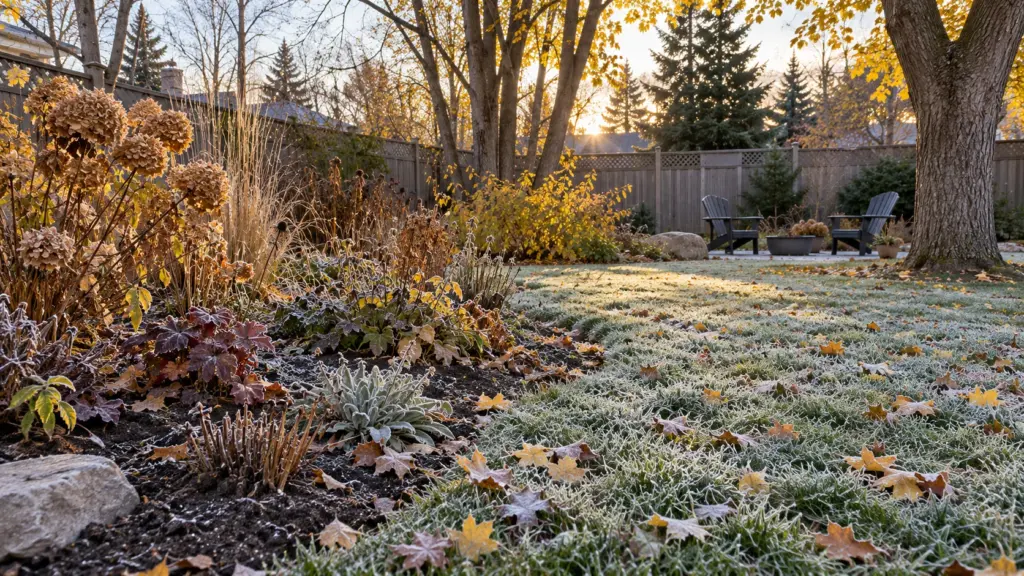
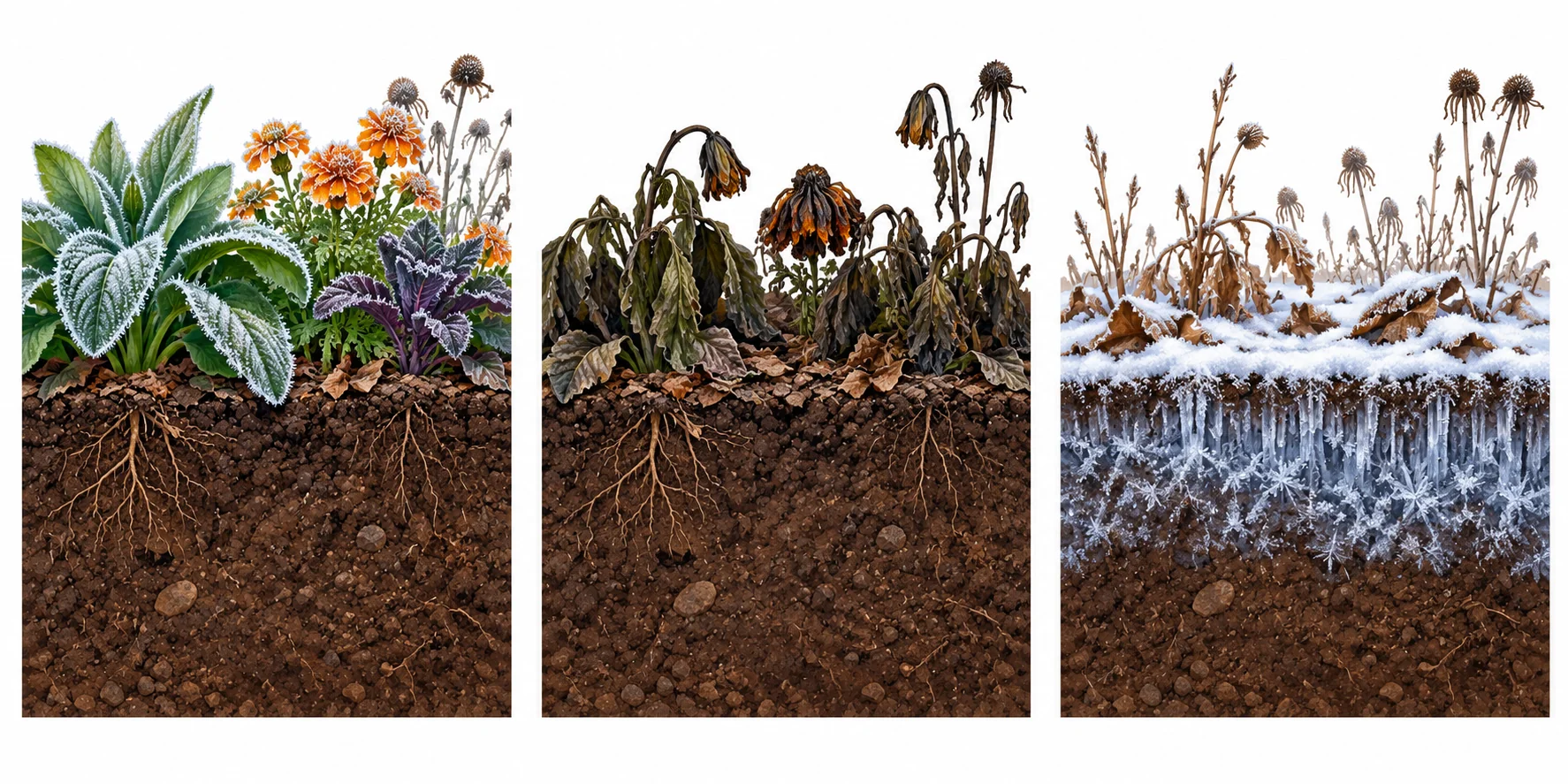
The key point: the first frost doesn't freeze the ground. Air temperature can dip below zero overnight in September while the soil a few inches down stays well above freezing for weeks.
Typical Winnipeg dates (Environment Canada climate normals)
All figures below come from Environment and Climate Change Canada's 1991–2020 Canadian Climate Normals for Winnipeg Richardson (Airport). They are measured at the airport, so your yard may run a little warmer or colder depending on location, shelter and low spots.
Frost dates
| Measure | Winnipeg normal |
|---|---|
| Average date of last spring frost | May 23 |
| Average date of first fall frost | September 22 |
| Average length of frost-free period | 122 days |
The averages hide a range. On the same page, Environment Canada also publishes the probability that the first fall temperature of 0°C or lower has happened by a given date. These probabilities are long-term figures based on the station's record from 1939 to 2016, not just 1991–2020:
| Probability first fall frost has happened by… | Date |
|---|---|
| 10% | September 12 |
| 25% | September 16 |
| 50% | September 22 |
| 75% | September 28 |
| 90% | October 3 |
In plain terms: a frost before mid-September is uncommon but possible, and by early October the first frost has almost always come and gone.
Hard freezes, cold days and snow, by month
| Normal (1991–2020) | September | October | November | December |
|---|---|---|---|---|
| Daily average temperature | 13.3°C | 5.1°C | −4.4°C | −12.7°C |
| Days with a low below −2°C | 0.82 | 10.4 | 24.3 | 30.7 |
| Days with a high of 0°C or lower | 0.0 | 1.0 | 14.8 | 26.9 |
| Snowfall | 0.0 cm | 4.2 cm | 21.1 cm | 27.2 cm |
| Snow depth at month-end | 0 cm | 1 cm | 6 cm | 14 cm |
What the table shows: nights below −2°C average fewer than one in September but about 10 in October. Snow in October is usually light. November is when the cold settles in: about half its days stay at or below 0°C all day, and it gets about five times October's snowfall.
Ground freeze has no official date
Environment Canada's normals don't publish a "ground freeze date" for Winnipeg, and we won't make one up. Soil freezes after a sustained stretch of cold, and the timing changes from year to year and from yard to yard. Bare, exposed ground freezes sooner. Ground under mulch, leaves or early snow freezes later. Go by what the ground is doing, not the calendar. If the soil is firm and frozen at the surface, it's freeze-up for your purposes.
What you can still do after the first frost
A first frost in late September doesn't close the yard. The limit for soil work is workable ground, not a date.
- Topsoil and bed building. Soil can still be placed while the ground is unfrozen and workable, but it needs time to settle before freeze-up. Our fall material list for Winnipeg puts it this way: early September is the comfortable window, late September may work in a mild year, and October is a gamble that usually doesn't pay off. For new beds, lawns and levelling, Four-Way Mix is our screened growing-soil blend.
- Planting and seeding. Anything you plant or seed needs time to root before the ground freezes. The later it goes in, the less time it gets. If you're planting after the first frost, pick hardy stock and water it in well.
- Covering beds on cold nights. After an early frost there are often mild weeks still to come. Covering tender plants overnight with breathable fabric can carry them through a light frost. A hard freeze is a different story.
- Buying winter mulch now, applying it later. This is the time to get mulch on site, not to spread it. Buy while the yard is open and stocked, then wait for the ground to freeze.
After the ground freezes: winter mulch and material piles
Once the ground is frozen, most of the list closes:
- No soil placement, grading or fill work.
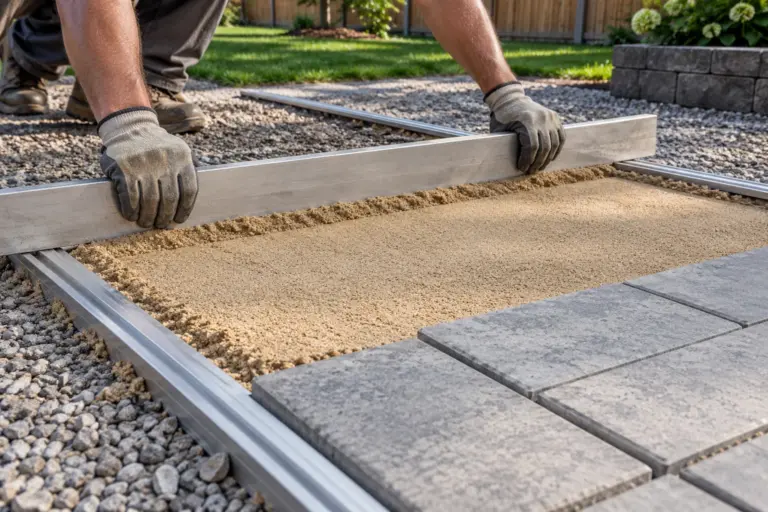
- No compaction, which rules out base preparation and most hardscape work.
- No digging, which rules out edging and anything that needs excavation.
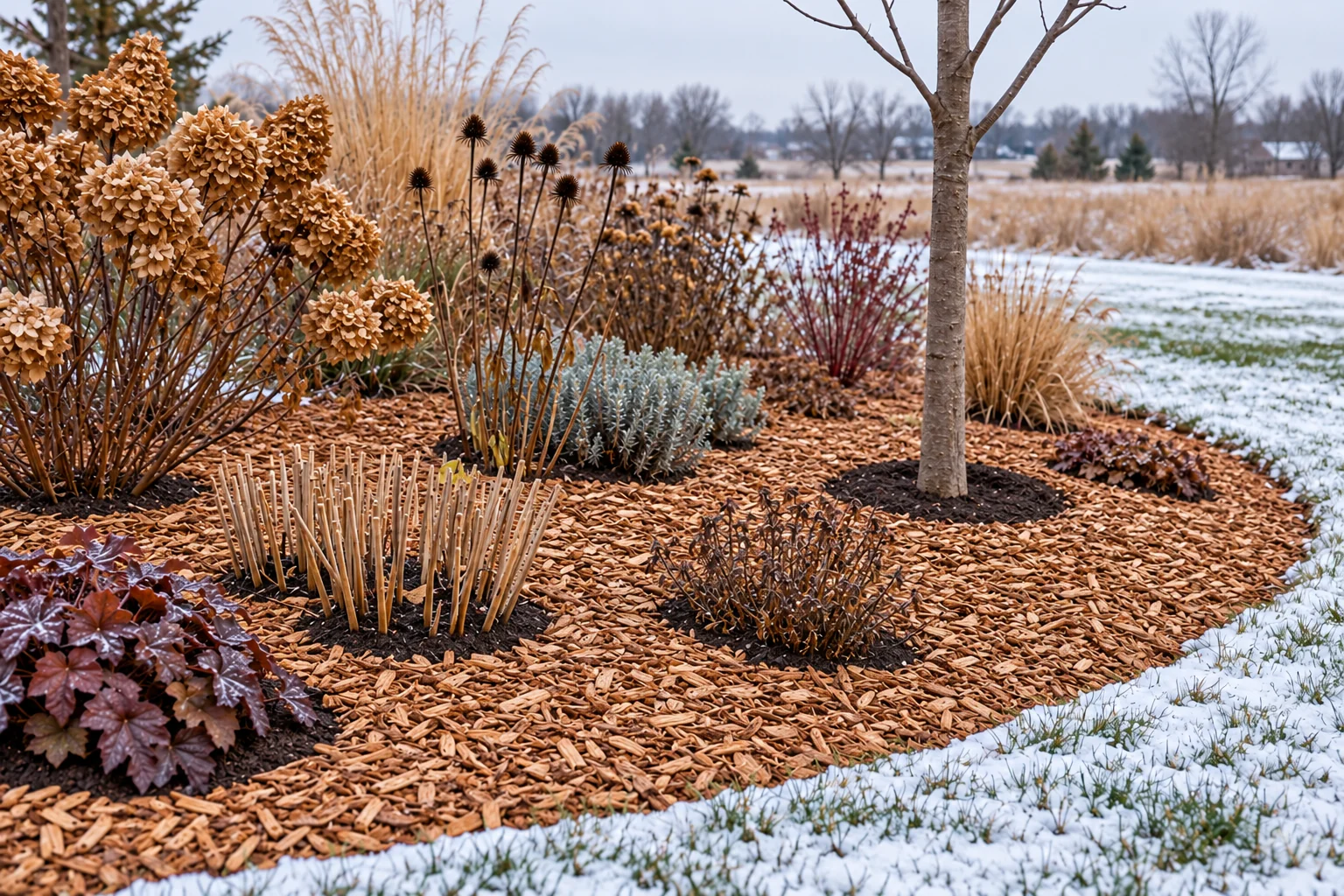
The one job that opens up is winter mulch. Applied after the soil has begun to freeze, mulch moderates temperature swings and reduces the freeze-thaw movement that lifts shallow roots. Applied to warm soil, it can keep the ground warm and delay dormancy. Aim for about 3 to 4 inches of loose organic mulch in total, counting any usable mulch already in the bed, and keep it off plant crowns, shrub stems and tree trunks. Our winter mulch guide for Winnipeg covers timing, depth and which plants benefit. Natural wood mulch works well for perennial beds, shrubs and tree rings.
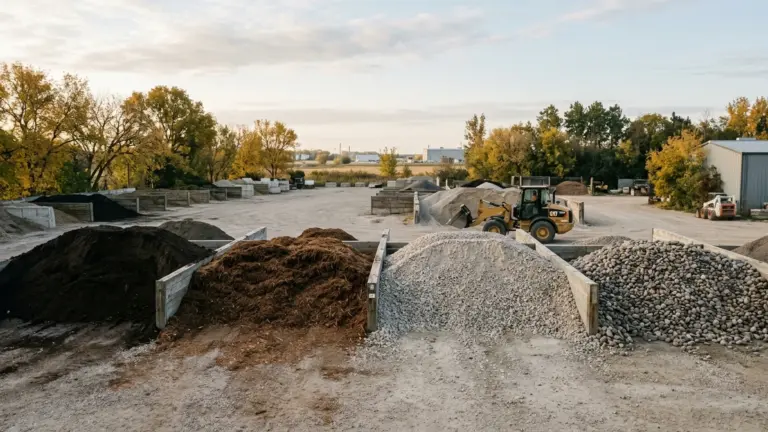
Material piles: if mulch or stone is staged on your property waiting for the right moment, keep it covered or in a spot where it won't be buried by the first snowfall. A pile that freezes solid under a snowbank is hard to spread evenly.
Deliveries don't stop at freeze-up. Material can still be bought and delivered as long as the yard is operating and the delivery site is accessible. What changes is what you can do with it once it arrives.
Frost line and frost heave
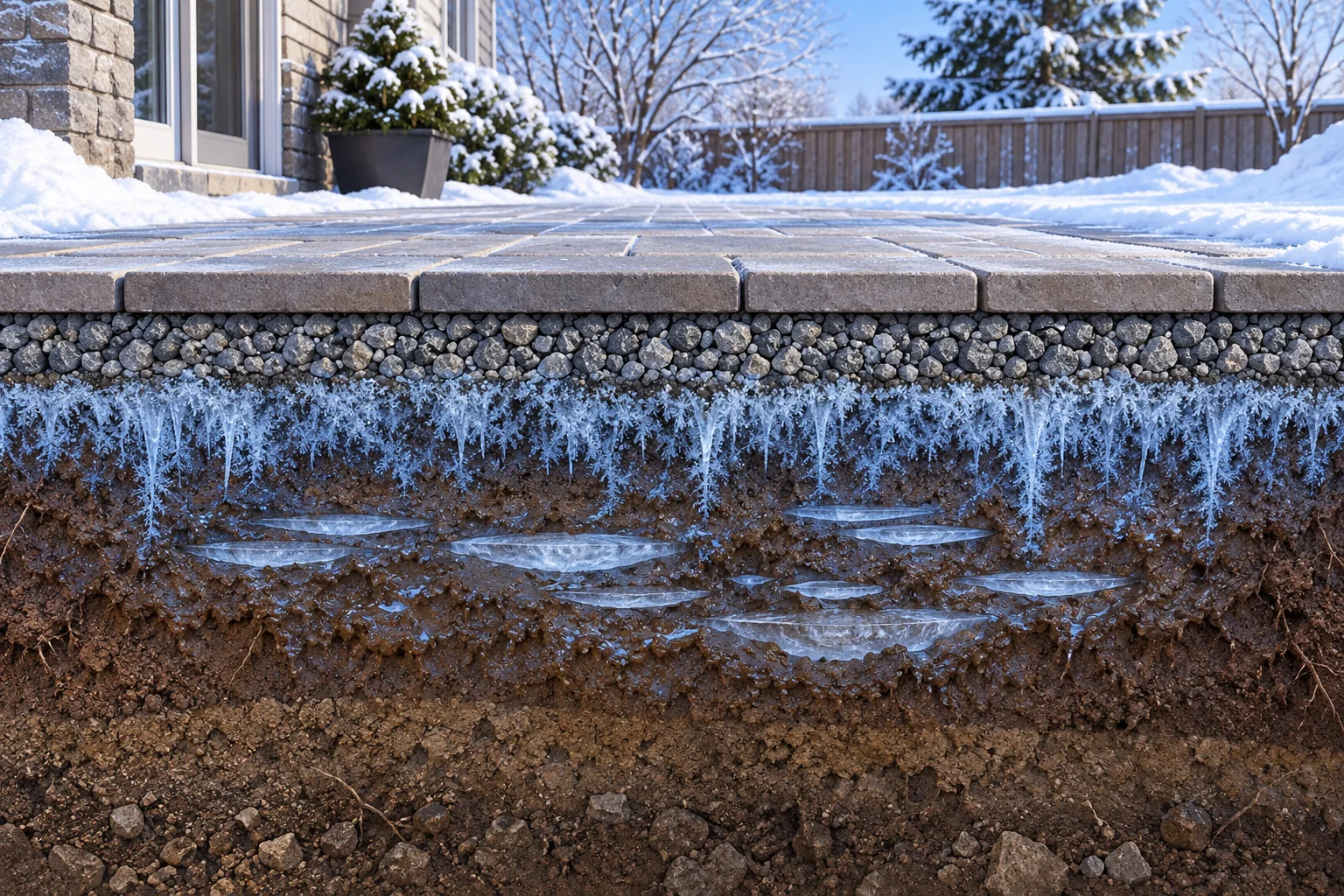
The frost line is how deep the ground freezes over the winter. In Winnipeg it goes deep, and it isn't the same everywhere or every year. A colder winter drives frost deeper. Snow cover insulates the ground, so frost generally goes deeper under cleared driveways, walks and roads than under a snow-covered lawn. Soil type and moisture matter too.
For building purposes, the City of Winnipeg's deck guide sets a working number: when a deck's joists sit more than 1300 mm (4'-3") above the ground, "the foundation depth must be at least the depth of frost penetration – 1.8 m (6-0")." Manitoba's provincial deck guide uses the same 1.8 m (6 ft) figure. That is a design depth, the depth a foundation has to reach to sit below the frost. It is not a measurement of how deep frost goes in your yard in a given winter.
That depth is why frost heave matters here. When water in the soil freezes, it expands, and soils that hold more water move more. Over a winter, and again in each freeze-thaw cycle in fall and spring, that movement can lift fence posts, shift patio stones, crack walkways and push shallow-rooted plants up out of the ground.
Two practical takeaways:
- For plants: winter mulch applied after freeze-up reduces the surface freeze-thaw swings that cause plants to heave.
- For hardscape: the base under a patio, path or driveway needs to drain and compact properly. Particle shape and gradation matter more than stone size. Our guide to the best gravel for frost heave in Winnipeg explains why angular, well-graded crushed stone holds up better than rounded stone like pea gravel.
FAQ: winter, frost and freeze-up in Winnipeg
When is the first frost in Winnipeg?
On average, September 22, according to Environment Canada's 1991–2020 climate normals for Winnipeg Richardson (Airport). In about one year in ten it has happened by September 12, and in about nine years in ten by October 3.
When does winter start in Winnipeg?
On the calendar, at the December solstice. In terms of weather, November is the first month with an average daily temperature below zero (−4.4°C), and it gets far more snow than October (21.1 cm vs 4.2 cm on average).
When is the last spring frost in Winnipeg?
On average, May 23, which gives Winnipeg an average frost-free period of 122 days.
When does the ground freeze in Winnipeg?
There isn't an official average date. It depends on a sustained stretch of cold, on snow cover and on your soil. Go by the ground itself: once the surface is firm and frozen, soil work is done for the year and winter mulch can go down.
Can I still put down topsoil after the first frost?
Often, yes. A first frost freezes plants, not the ground. The limit is workable, unfrozen soil and enough time for it to settle before freeze-up. Earlier is better.
How deep does frost go in Winnipeg?
Deep, and it varies with the winter, the snow cover and the soil. For deck foundations, the City of Winnipeg uses 1.8 m (6 ft) as the depth of frost penetration that deep foundations must reach. That's why base materials and drainage matter so much for patios, paths and posts.
Is a hard freeze the same as a frost?
No. Frost means 0°C or lower. A hard freeze is colder, commonly about −2°C or lower, and kills most plants that aren't dormant.
Get your fall and winter materials
Need Four-Way Mix while the ground is still workable, or winter mulch staged for freeze-up? Browse Ditchfield's landscape materials or order through the Ditchfield online store. Pickup is available at the yard during current hours, with delivery across Winnipeg and surrounding areas. Call to confirm stock before a large order.
Ditchfield Supplies · 2929 Sturgeon Rd, Winnipeg, MB R2Y 2L9 · 204-889-6268
Would you rather have the fall cleanup and winter protection done for you? Our sister company Lawn 'N' Order provides those services.