Bedding sand is one of the smallest parts of a paver project and one of the easiest to get wrong. It is a thin layer, it is cheap compared to the pavers, and it is often confused with the base below it or the jointing sand above it. Get it right and your patio or walkway sits flat and even. Get it wrong and the surface can rock, dip or hold water.
Here is what bedding sand does, which material belongs in each layer, and how to work out how much to order.
What Bedding Sand Does
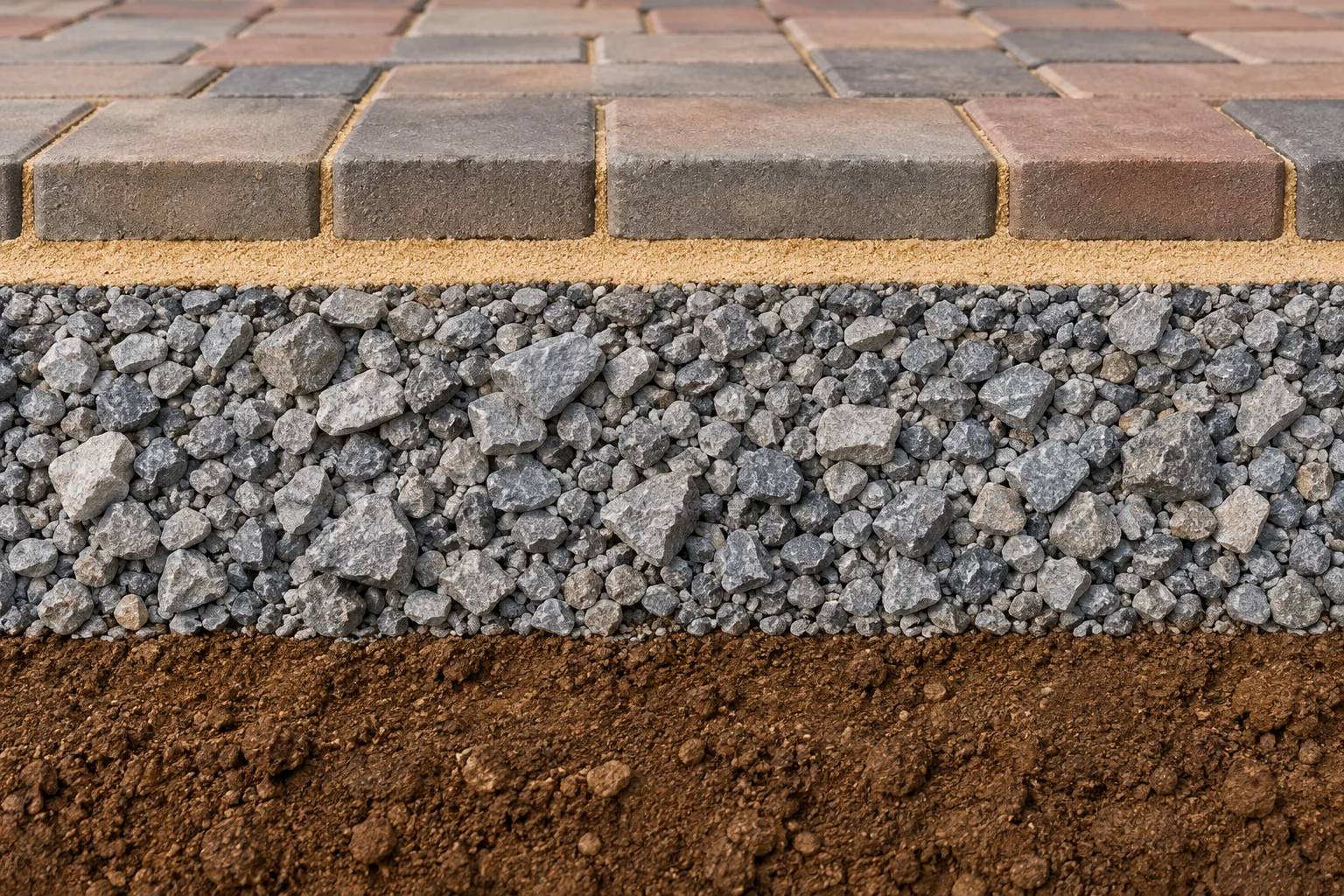
A conventional sand-set interlocking paver installation is built in layers. Our guide to screenings and stone dust for paver base work describes the following example, from the bottom up. Actual aggregate depths depend on the soil, drainage and expected loads:
- Subgrade: native soil, graded to drain and compacted.
- Sub-base: compacted granular material, typically 100 to 150 mm deep for residential work.
- Base: a second compacted granular layer, about 50 mm deep, directly below the bedding course.
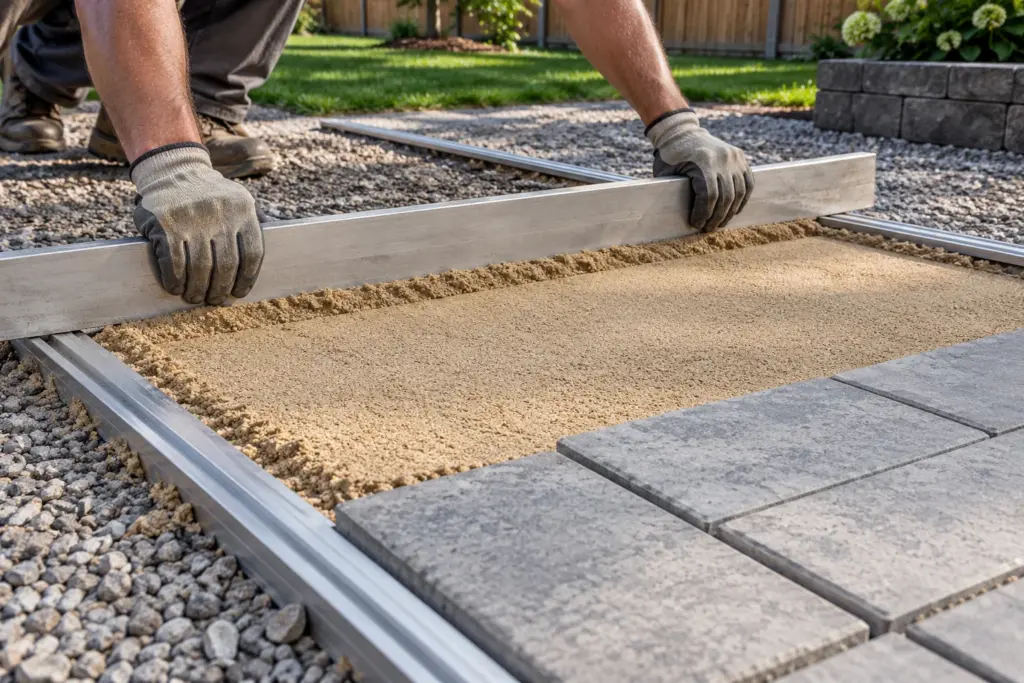
- Bedding course (setting bed): the thin, uncompacted layer, about 25 to 30 mm deep, on which pavers are set and levelled.
- Pavers: set on the bedding course and compacted into final position.
The bedding course is the layer that lets you set each paver at exactly the right height. It is screeded flat and left loose. When the pavers are compacted on top, they settle slightly into it, and the sand fills the small irregularities on the underside of each unit so it sits evenly.
The bedding course does not carry the structure. The compacted base does. Bedding sand is the fine-tuning layer on top.
Which Material Goes Where
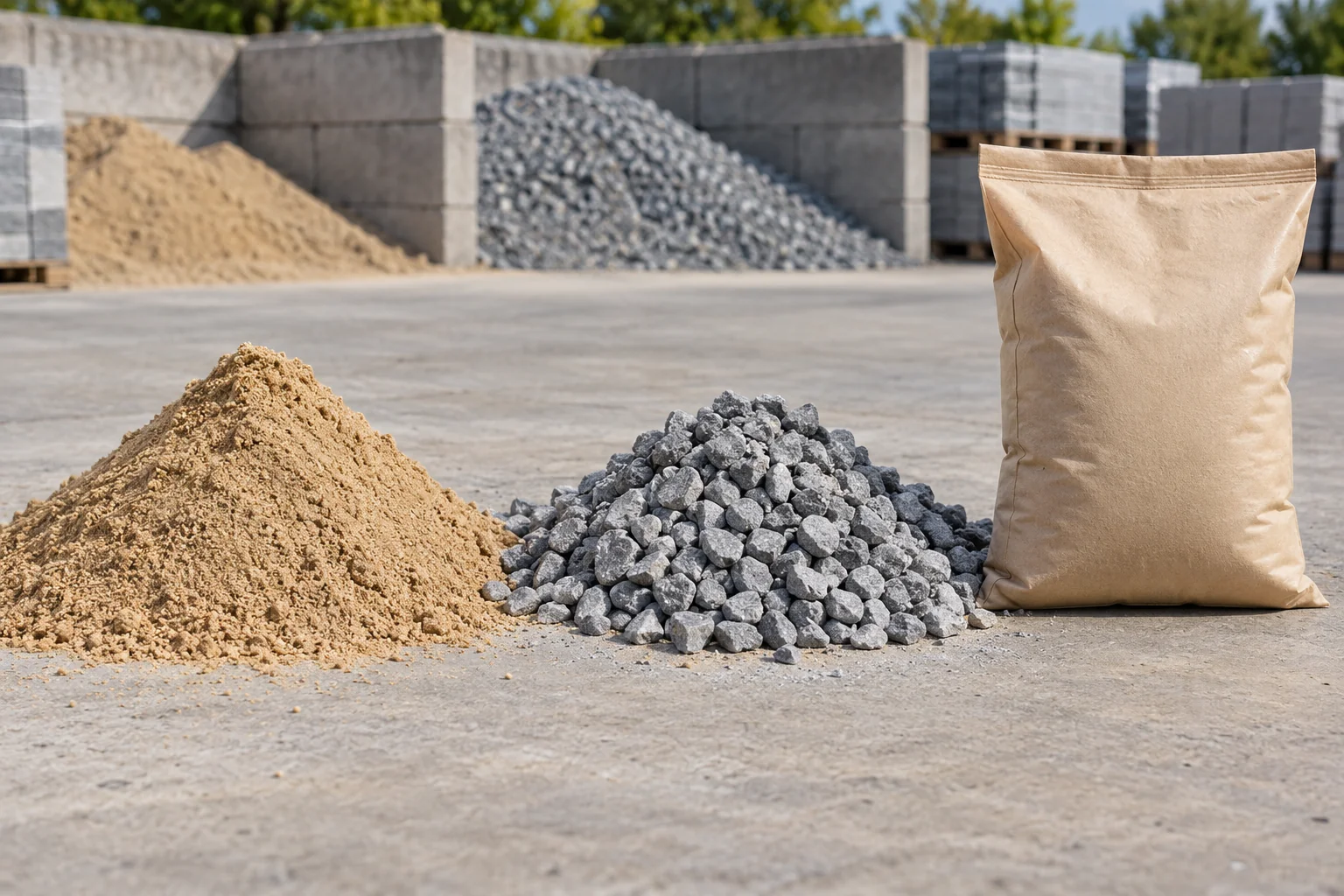
Most problems come from putting the right material in the wrong layer. Each of the three materials below has its own job.
Washed sand: the bedding course
For a conventional sand-set system, use washed concrete sand with the grading specified for paver bedding. CMHA guidance calls for ASTM C33 or CSA A23.1 sand. Confirm that the supplied sand meets your installer’s requirements; not every product sold simply as washed sand has the same grading.
Ditchfield's Washed Sand is listed for bedding, levelling, slabs and concrete-related landscape work. The product page lists a CAD $46 per cubic yard reference price, checked October 30, 2026. Confirm current pricing, grading and availability before ordering. Delivery charges and pickup surcharges may apply.
Crushed limestone: the base
The base is where strength comes from. Angular crushed limestone compacts into a dense, interlocked layer that resists settling and frost movement. It is compacted in lifts with a plate compactor, unlike the bedding sand above it.
See Crushed Limestone for current pricing, and our comparison of crushed limestone vs clear stone if you are deciding between base materials.
Polymeric sand: the joints
Polymeric sand goes between the pavers, not under them. It is swept into the joints after the pavers are set and compacted, then activated with water so it hardens and locks the joints against washout, weeds and ants. Polymeric sand is available in store.
A common mistake is using polymeric sand, or screenings, as bedding. Screenings hold fines and moisture in the setting bed, and polymeric sand is designed to harden, which is the opposite of what a bedding course needs to do.
How Deep and How Much
Bedding sand is ordered by volume. To work out how much you need:
Cubic yards = area (sq ft) × depth (inches) ÷ 12 ÷ 27
For a conventional sand-set paver system, CMHA guidance uses a nominal uncompacted depth of 1 inch (25 mm). Follow the paver manufacturer’s installation specification. Measure the area, multiply by the specified depth, and convert.
Example: a 200 square foot patio with a 1 inch bedding course. 200 × 1 ÷ 12 ÷ 27 = about 0.62 cubic yards of washed sand.
Use the same formula for the base layers with their depths: about 2 inches (50 mm) for the base, and about 4 to 6 inches (100 to 150 mm) for the sub-base on residential work. For the same 200 square foot patio, that works out to about 1.2 cubic yards for the base and about 2.5 to 3.7 cubic yards for the sub-base. These layer depths illustrate the calculation; they are not a site-specific design recommendation for Winnipeg clay or vehicle traffic.
Round up when you order. Edges, uneven ground and screeding always use a little more than the plan says. If you would rather not do the maths, our calculator on the Ditchfield site can help, or call us and we will work it out with you.
Prices change, so we do not build totals on them here. Check the Washed Sand and Crushed Limestone pages for current pricing.
Preparing the Base Under the Sand
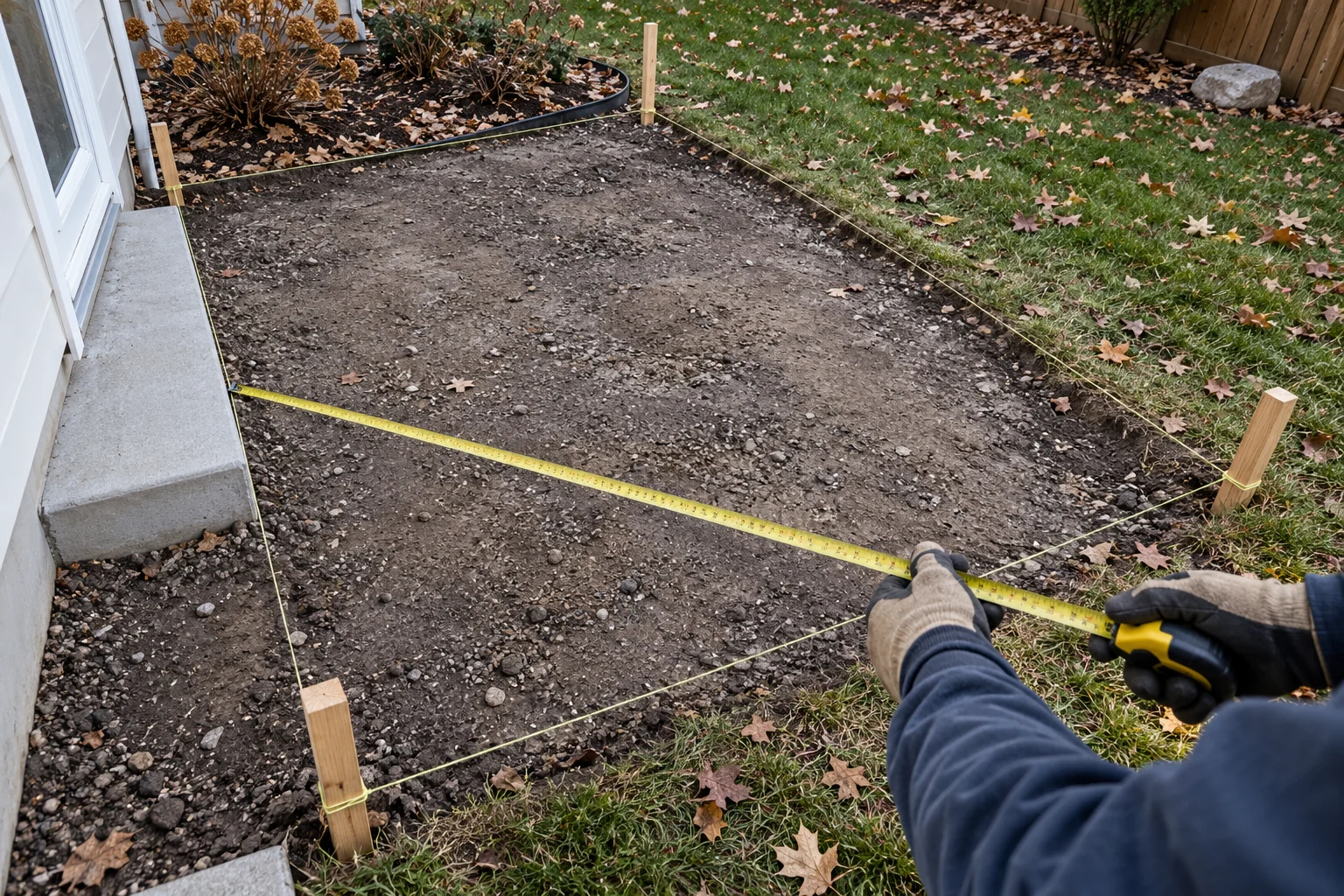
Bedding sand cannot fix a poor base. If the base has soft spots, high spots or poor drainage, they will show through the pavers no matter how carefully the sand is screeded. Before the sand goes down:
- Excavate deep enough for the full build-up of sub-base, base, bedding and paver.
- Grade the subgrade so water drains away from buildings.
- Compact the base in lifts until it is firm and even.
- Keep the bedding course at a consistent depth. Do not use extra sand to fill dips in the base. Fix the base instead.
Late Fall vs Spring Installation
Bedding sand and base work are mostly a question of ground conditions. Once the ground starts to freeze, excavating and compacting properly gets difficult, and frozen or saturated material should not be built on.
The bigger timing issue is the joints. Our guide to installing polymeric sand in Winnipeg recommends May through mid-September, treats late September as marginal and advises against October installations. Its planning target is 48 hours above 10 degrees Celsius with no frost forecast and no rain for at least 24 hours after activation. Product instructions vary: follow the exact sand manufacturer’s temperature, watering and cure requirements.
So if you are planning a patio now, the practical approach is to plan in the fall and build in the spring. Measure the area, work out your quantities with the formula above, and book your materials so you are ready once the ground is workable.
FAQ
What is bedding sand?
Bedding sand is the thin, uncompacted layer of sand, about 25 to 30 mm deep, that pavers are set and levelled on. It sits on top of the compacted base.
What sand do you use for paver bedding?
For a conventional sand-set system, use washed concrete sand meeting the specified ASTM C33 or CSA A23.1 grading, rather than assuming any washed sand is suitable.
Can I use screenings or stone dust as bedding sand?
Do not substitute them for specified concrete bedding sand. Base materials must also meet the project’s aggregate specification.
Should bedding sand be compacted?
Not before the pavers go down. It is screeded flat and left loose, then the pavers are compacted into it.
How much bedding sand do I need?
Multiply the area in square feet by the depth in inches, divide by 12, then divide by 27 to get cubic yards. A 200 square foot area at 1 inch needs about 0.62 cubic yards.
Is it too late to install pavers this fall?
For polymeric sand joints, October and later is not recommended in Winnipeg. Plan now and install in spring.
Order Your Paver Materials
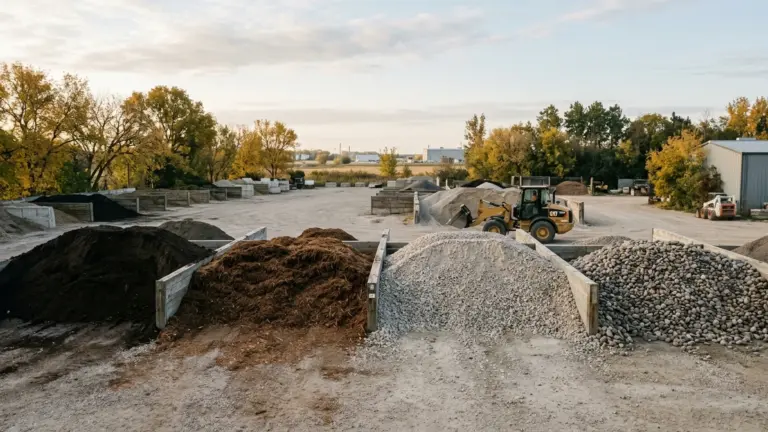
Ditchfield Supplies supplies washed sand, crushed limestone and polymeric sand from our yard at 2929 Sturgeon Rd, with delivery across Winnipeg and surrounding areas. Call 204-889-6268 or get a quote.
Installation reference
See CMHA: Construction of Interlocking Concrete Pavements for conventional sand-set paver bedding guidance. The paver system, soil, drainage and traffic determine the final installation specification.