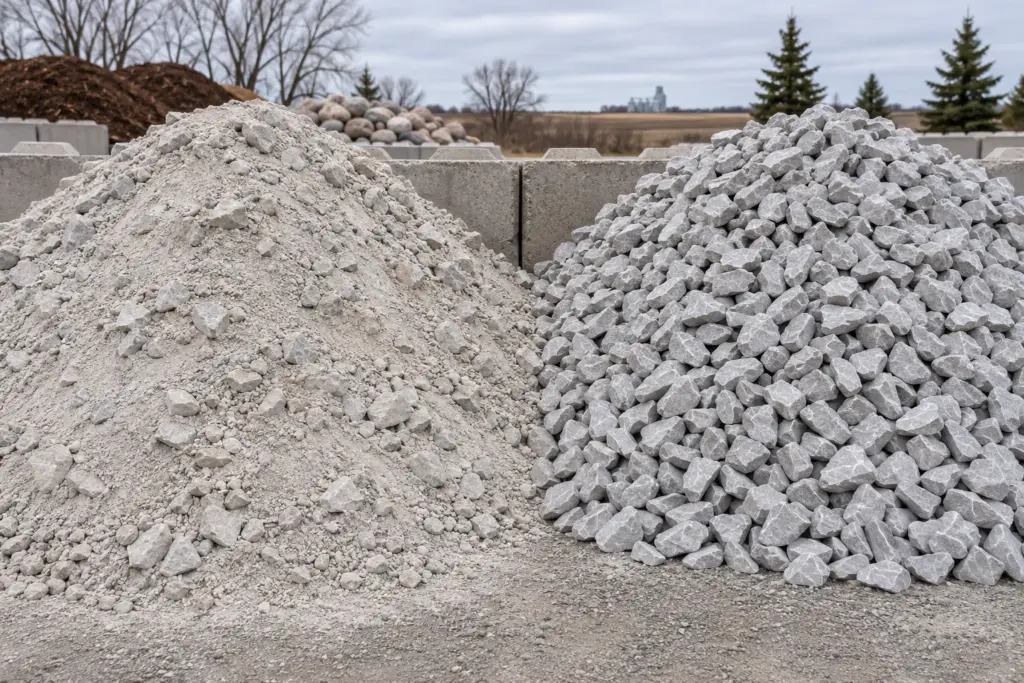
Limestone gravel gets sold under a lot of names: clean, clear, down, minus, quarter down, three-quarter down. They are not interchangeable. The difference comes down to one thing: whether the stone includes the small particles and fines that let it pack tight. Get that right and you know which layer each material belongs in.
Quarter down vs 3/4 down gravel: grades, not brands
The number in front of "down" is the top size of the stone.
- 3/4 down gravel contains pieces up to about 3/4 inch, together with smaller particles and fines.
- Quarter down gravel (also written 1/4 down or 1/4 minus) tops out at about 1/4 inch, so it is a much finer material.
Both are "down" grades, so both compact. They suit different layers.
Which layer each suits
3/4 down is a base material. Its larger angular pieces give a compacted layer the strength to carry weight. It is the grade commonly chosen for the main base under driveways, walkways, patios and other hardscape.
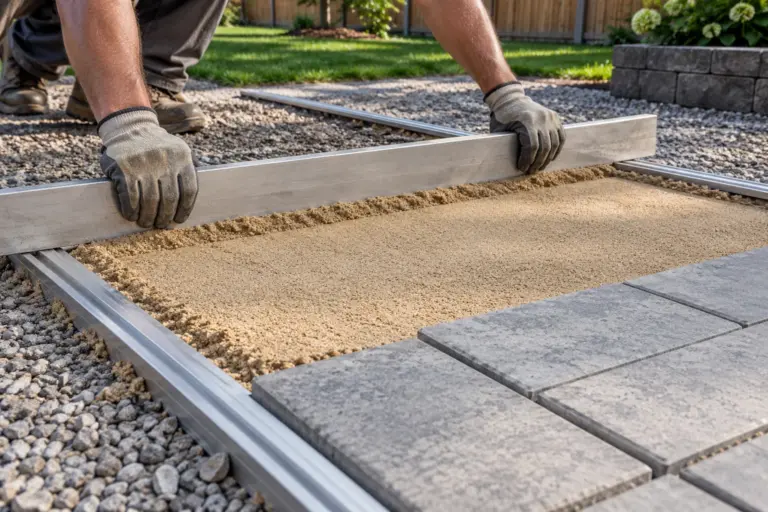
Quarter down is a fine finishing or levelling material. Its smaller size makes it easier to grade smooth, so it tends to be used as a thin top layer, for example on a path surface or to fine-tune grade over a coarser base. It is not a substitute for the main structural base.
Two cautions:
- For conventional sand-set pavers, use washed concrete sand that meets the specified grading, following the paver manufacturer’s instructions. Neither down grade is a substitute. Our bedding sand for pavers guide explains material and quantities.
- The right grade and depth depend on the load, the soil and the drainage on your site. Limestone does not correct a grading or drainage problem. If water is pooling or the ground heaves, see our guide to the best gravel for frost heave.
Down vs clean limestone
Down limestone is crushed stone graded from a top size "down" to fines. The angular pieces lock together, and the smaller particles fill the gaps between them. When it is placed in layers and compacted, it forms a dense, firm base. That is why down limestone is the usual choice under driveways, walkways and patios.
Clean (or clear) limestone has had the fines removed, leaving open spaces for water to move through. It is often used around drainpipe or behind retaining walls. Properly specified open-graded aggregate can also serve as a structural base in systems designed for it.
The trade-off is simple:
- Down limestone packs tight but drains slowly.
- Clean limestone drains more freely and behaves differently from dense-graded base material.
Match the aggregate to the design. Fines can impede drainage around a drainpipe, while swapping clean stone into a conventional dense-graded driveway base changes how it behaves. For a deeper look, read crushed limestone vs clear stone.
Fall top-ups and compacting before freeze-up
A season of traffic and rain leaves most gravel driveways and paths with ruts, low spots and thin areas. Fall is the time to fix them, while the material can still be worked and compacted.
- Fill low spots and ruts. Rake out loose material, then add down limestone to bring the area back to grade.
- Work in thin layers. Spread the stone in lifts rather than one thick dump, so each layer compacts properly.
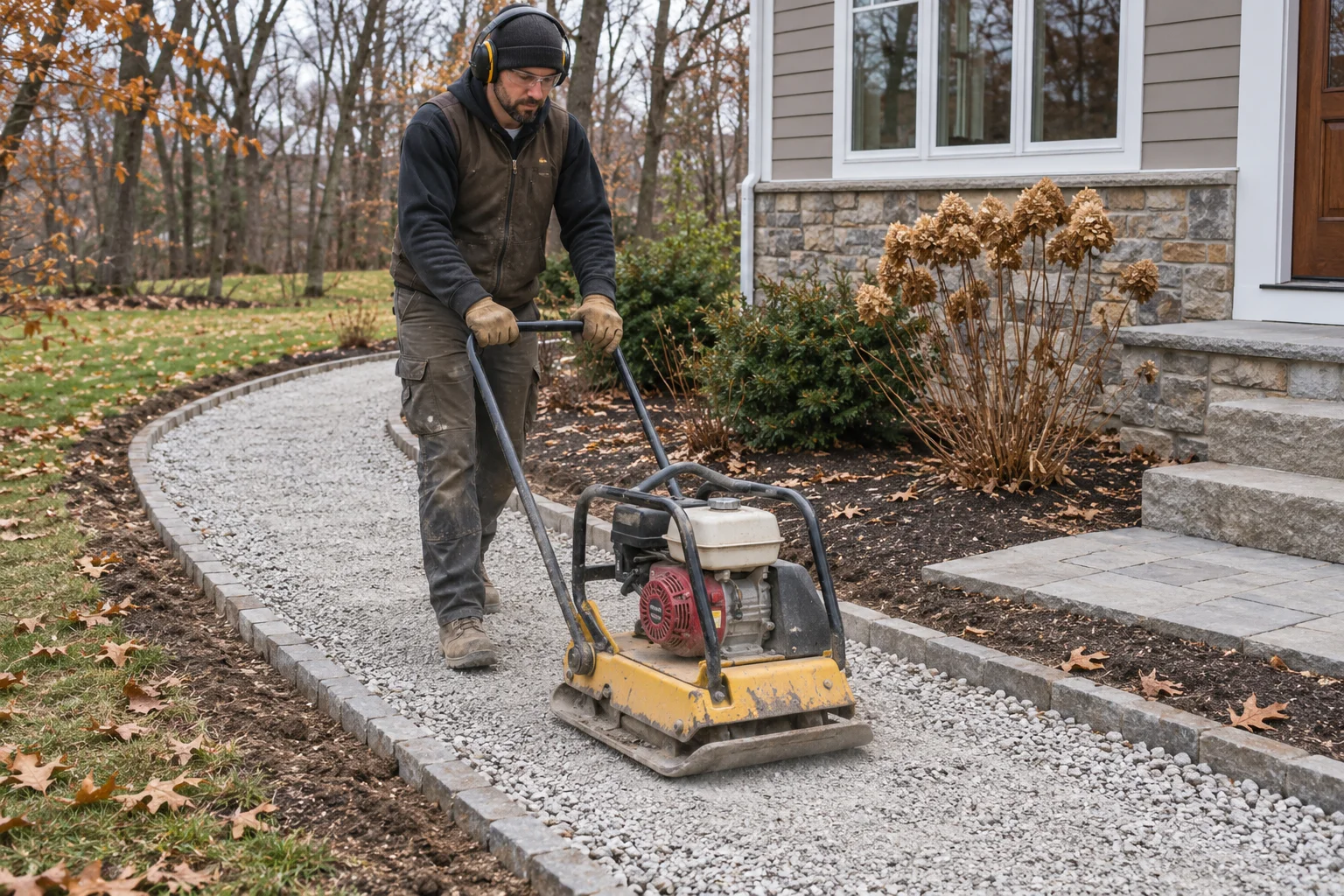
- Compact each layer. A plate compactor is the usual tool. Slightly damp material packs better than bone dry stone.
- Shape for runoff. Leave a slight crown or slope so water runs off rather than sitting on the surface and freezing.
- Finish before the ground freezes. Once the base is frozen, it can't be properly compacted, and loose stone on top is easy for a plow blade or snow blower to scatter.
How much gravel do you need?
Measure the area and decide the compacted depth you need. For a preliminary volume in cubic yards:
Length (ft) x Width (ft) x Depth (in) ÷ 324 = cubic yards
For example, a path 20 ft long and 4 ft wide at 3 inches deep works out to 20 × 4 × 3 ÷ 324, or about 0.74 cubic yards. Use the material calculator for other dimensions and ask the yard about allowances for compaction and uneven ground.
What Ditchfield supplies
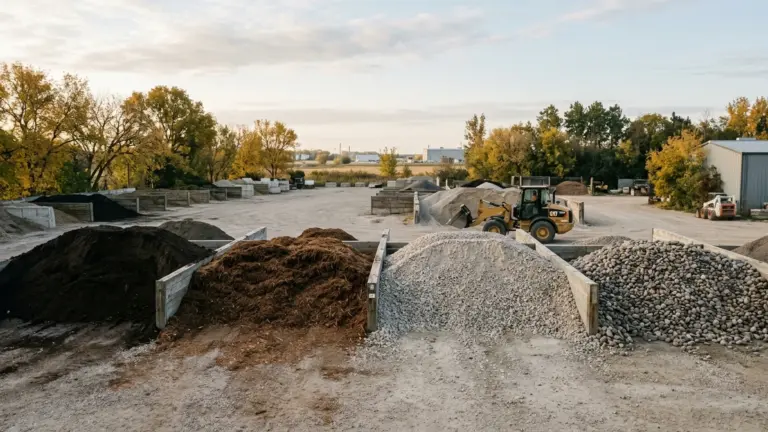
Ditchfield lists 3/4 Down Crushed Limestone for driveway, walkway and patio base preparation. Call 204-889-6268 to confirm current stock or ask about quarter down and other grades.
Choosing by the job:
- For a base layer, 3/4 down is the standard choice and will carry more load than a fine grade.
- For a smooth finished surface or fine levelling, tell us what the layer has to do and we'll help you pick a suitable material.
- For conventional sand-set paver bedding, use washed concrete sand that meets the project specification. See our bedding sand for pavers guide.
Browse all our products, or call 204-889-6268. Pickup is available at 2929 Sturgeon Rd; ask about delivery to your address before ordering.