Quick Takeaways
- Firewood of any species cannot leave the City of Winnipeg without written permission from the Canadian Food Inspection Agency. Winnipeg is a regulated area for emerald ash borer, and the restriction covers all species, not just ash.
- That makes the cottage run the single most common mistake. Buy firewood where you are going to burn it, in both directions.
- Elm is in a category of its own under Manitoba’s forest health rules and is not a firewood option. Stacking elm as firewood is a storage violation.
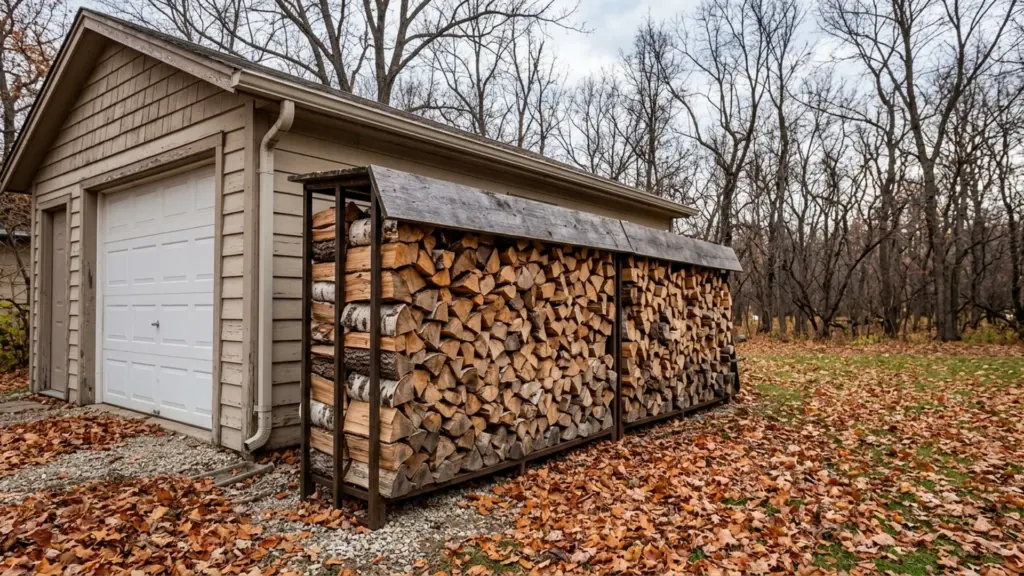
- Store it off the ground, covered on top and open at the sides, and away from the house. A tarp wrapped over the whole stack traps moisture and undoes the seasoning.
- Winnipeg does not require a permit for a residential fire pit, but the bylaw sets conditions, including that only clean, dry, untreated and unpainted wood may be burned and that fires are not permitted when the wind exceeds 25 km/h.
Start With the Rule That Catches People Out
Before anything about species, seasoning or stacking, there is one rule that matters more than the rest, because breaking it is easy to do by accident and the consequences are not local.
Firewood of all species cannot be moved out of the City of Winnipeg without written permission from the Canadian Food Inspection Agency. The Province of Manitoba states it plainly: the City of Winnipeg is regulated for the movement of firewood and ash wood, and firewood of any species cannot leave the city. The provincial firewood movement page and the CFIA’s emerald ash borer page both set this out.
The reason is emerald ash borer, which was confirmed in Winnipeg in 2017 and has made the city a regulated area since. The insect travels short distances on its own and long distances in firewood. A trunk full of split wood driven to a lake lot is how an infestation moves two hundred kilometres in an afternoon.
The practical implication for a Winnipeg buyer is simple and worth being blunt about: firewood bought here is for burning here. Do not take it to Whiteshell, Falcon Lake, Gimli, Riding Mountain or anywhere else outside the city. The same thinking applies in reverse to bringing wood in. Importing firewood from the United States is not a casual option either, since it requires a CFIA import permit, heat treatment and a phytosanitary certificate, and firewood from American areas regulated for emerald ash borer is not admissible at all. None of that is something you can arrange with a trunk full of wood at the border.
If you genuinely need to move wood out of the regulated area, that is a question for the CFIA, not for a supplier. Written permission is the mechanism and it is theirs to grant. The rule of thumb that fits every other case is the one the City uses: burn firewood where you buy it.
Ash and Elm Are Separate Problems
Ash
No part of an ash tree can leave Winnipeg. If you are taking down an ash on your property, the City’s guidance is to chip the material on site, take the chips to the Brady Road Resource Management Facility without leaving the regulated area, or burn the material on site, which requires an open air fire permit. Ash from your own yard is not firewood you can stockpile and take somewhere.
Elm
Elm is governed separately, under Manitoba’s forest health rules, and the restriction is on storage rather than just movement. Elm wood cannot be stored unless it has been debarked, chipped or heat treated, and it is meant to go to a designated disposal site. Stacking elm as firewood in the back yard is exactly the thing the rule prohibits, because an elm woodpile is a breeding site for the beetle that spreads Dutch elm disease. The tree and branch waste guide covers the elm rules, the pruning ban window and the approved disposal routes in full.
The short version for anyone offered free elm: it is not a bargain, it is a disposal problem with a handshake attached.
What Ditchfield Carries
Ditchfield stocks seasoned pine firewood, sold by the bundle or by the bucket. Current sizes, pricing and availability are on the firewood and driftwood product page. Decorative driftwood is available by enquiry. Stock moves through the season, so confirm what is in the yard before making the trip.
Pine gets dismissed by people who grew up burning hardwood, and some of that reputation is earned and some of it is not. What is true is that pine is lower density, so a given volume holds less energy than the same volume of oak or ash. It burns hot, burns fast and produces less of a long-lived coal bed. For an outdoor fire pit, a chiminea or a shoulder-season fire where you want heat quickly and are not trying to hold a bed of coals overnight, that behaviour is a feature rather than a flaw.
What is not true is the idea that pine is inherently a creosote problem because of its resin. Creosote is driven primarily by burning wood that is not dry and by running a flue cool enough for the smoke to condense. Dry softwood burned in a hot fire is not the culprit; wet wood of any species smouldering in a cool chimney is. If you are burning indoors, the dryness of the wood and the temperature of the flue matter far more than the species, and regular chimney inspection matters more than either.
Pine does carry a second advantage in a Manitoba climate: it seasons faster. Split pine stored correctly will usually get there within the six to twelve month window, where a dense hardwood can want eighteen months or more.
How to Tell Seasoned Wood from Green
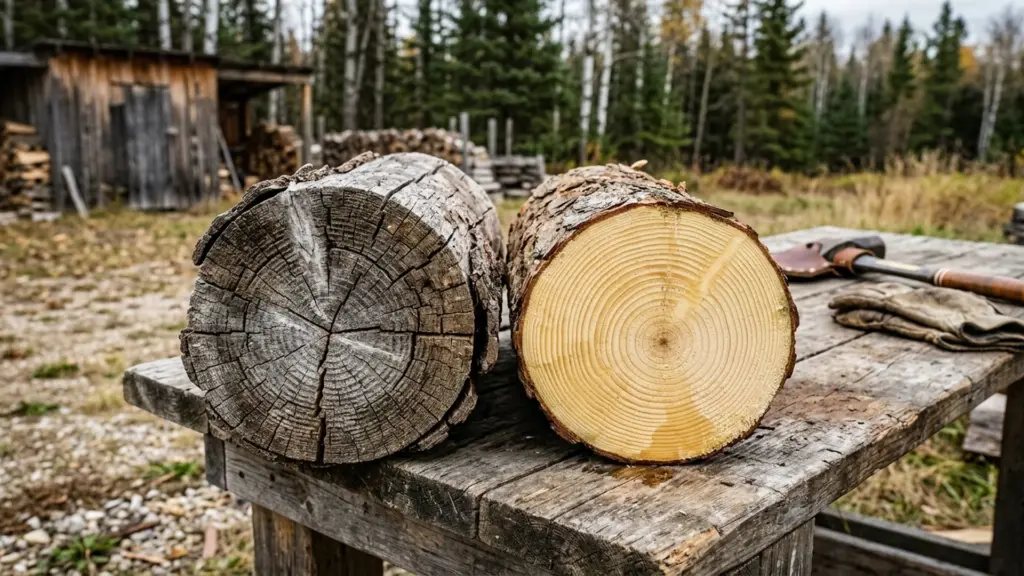
The benchmark for properly seasoned firewood is roughly 15 to 20 percent moisture, which is the range used in our Firewood and Driftwood 101 guide along with the six to twelve month drying time and why wet wood produces more smoke and creosote. That guide covers the why. This is the part it does not cover: how to tell, standing in front of a pile, which one you are looking at.
You do not need a meter to make a reasonable judgement, though a moisture meter is inexpensive and settles the question outright.
| Check | Seasoned | Green |
|---|---|---|
| Weight | Noticeably light for its size | Heavy, dense in the hand |
| End grain | Visible radial cracks and checks | Smooth, no splitting at the ends |
| Colour | Grey or faded, weathered look | Fresh, pale, close to the colour of new-cut wood |
| Bark | Loose, peeling or already gone | Tight to the wood |
| Sound | Sharp, hollow knock when two pieces meet | Dull thud |
| Smell | Faint | Strong sap or resin smell |
| Burning | Catches readily, steady flame | Hisses, bubbles at the ends, smokes heavily |
The weight test is the one to rely on if you only do one. Wood loses most of its weight as it loses water, and the difference between a seasoned split and a green one of the same size is obvious the moment you pick both up.
Storing Firewood Through a Winnipeg Winter
Storage either maintains seasoning or undoes it. These are the specifics, whether you bought a bundle for a few fire pit evenings or enough to run through the season.
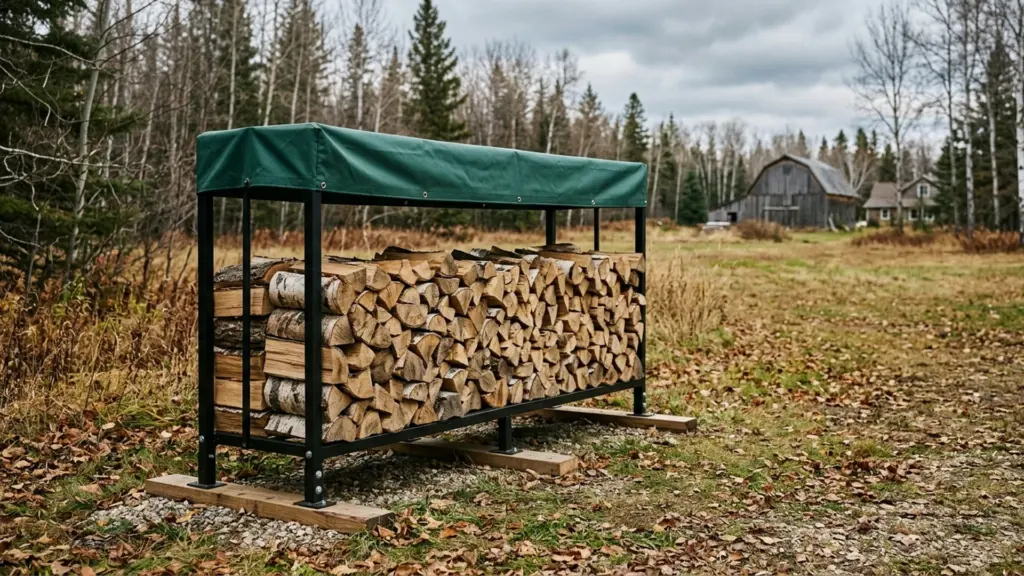
- Get it off the ground. Ground contact wicks moisture straight back into the bottom row and invites rot and insects. Pallets, a couple of rails, a purpose-built rack, anything that creates an air gap underneath.
- Cover the top, leave the sides open. This is the one most people get wrong. A tarp wrapped around the whole stack turns it into a humidity chamber and the wood will be wetter in spring than it was in fall. Cover the top third to keep snow and rain off, and let air move through the sides.
- Stack it where the air moves. A single row exposed to sun and prevailing wind dries fastest. If you are stacking deeper than one row, leave gaps between rows rather than packing them tight.
- Keep it away from the house. A woodpile against siding holds moisture against the wall and gives mice, carpenter ants and other insects a staging area a step from your foundation. Several feet of clearance is the usual advice, and the same thinking applies to stacking against a fence or a shed wall.
- Bring in only a few days at a time. Wood stored inside warms up and anything living in it wakes up. A few days’ worth in a rack by the door is the right amount, not a month’s supply in the basement.
- Think about where it will be in January. A stack at the back of the yard is a reasonable idea in October and a trudge through drifted snow in February. Put it somewhere you can reach on a path you will actually clear.
Where You Can Burn It
Winnipeg does not require a permit to operate a fire pit in a residential yard, but the bylaw sets conditions. The City’s requirements are that the pit is enclosed on all sides and built of brick, concrete, heavy gauge metal or other non-combustible material, that the opening is covered by a spark arrestor, grille or mesh, and that it sits at least ten feet from other structures.
Three operating rules go with that, and they are the ones most often missed:
- A supply of water, sand or another means of extinguishing the fire has to be readily accessible
- The fire has to be supervised by a person 18 years of age
- Fires are not permitted when the wind exceeds 25 km/h, which on a prairie spring or fall evening rules out more days than people expect
On fuel, the City is specific: only clean, dry, untreated and unpainted wood may be burned within city limits, and burning yard waste is not permitted. That rules out construction offcuts, pressure-treated lumber, pallets with painted or treated components, and the pile of branches from the spring pruning. It is also another reason seasoned wood matters, since a fire pit burning wet wood produces the smoke that generates complaints.
Open air fires, which is a different category from a backyard fire pit, do require a permit. Burning ash material on site after a tree removal falls into that category.
FAQ: Firewood in Winnipeg
Can I take firewood to the cottage?
No. Firewood of any species cannot leave the City of Winnipeg without written permission from the Canadian Food Inspection Agency, and that restriction exists specifically to stop emerald ash borer travelling to places it has not reached. Buy your wood near the cottage instead. It is a genuine rule with a genuine reason, not a formality.
Is pine actually worth burning?
For outdoor fires, yes. It lights easily, burns hot and produces a lively flame, which is what most people want from a fire pit. It burns through faster than hardwood and leaves a thinner coal bed, so you feed it more often. For an indoor wood stove where you want long steady heat overnight, the faster burn is a real limitation, but the species matters far less than whether the wood is dry.
Someone offered me free elm. Should I take it?
No. Elm wood cannot be stored in Manitoba unless it has been debarked, chipped or heat treated, so a stack of elm rounds in the yard is a violation rather than a woodpile. Elm is meant to go to designated disposal. Free elm is somebody else’s disposal cost being handed to you.
Can I burn the branches from my yard in a fire pit?
No. The City’s rule is that only clean, dry, untreated and unpainted wood may be burned, and burning yard waste is not permitted. Branches and prunings are yard waste. If the material is elm or ash, there are additional rules about how it has to be handled regardless of whether you intended to burn it.
How windy is too windy for a fire pit?
The City’s threshold is 25 km/h. That is not an unusual wind speed in Winnipeg, so it is worth checking before lighting rather than after the neighbours do. The spark arrestor requirement and the ten-foot setback exist for the same reason.
Pick Up Firewood at the Yard
Ditchfield carries seasoned pine firewood at the Winnipeg yard alongside mulch, soil and aggregate, sold by the bundle or the bucket. Current sizes and availability are on the firewood and driftwood page, and the Firewood and Driftwood 101 guide covers seasoning and delivery options. And whatever you buy here, burn it here.