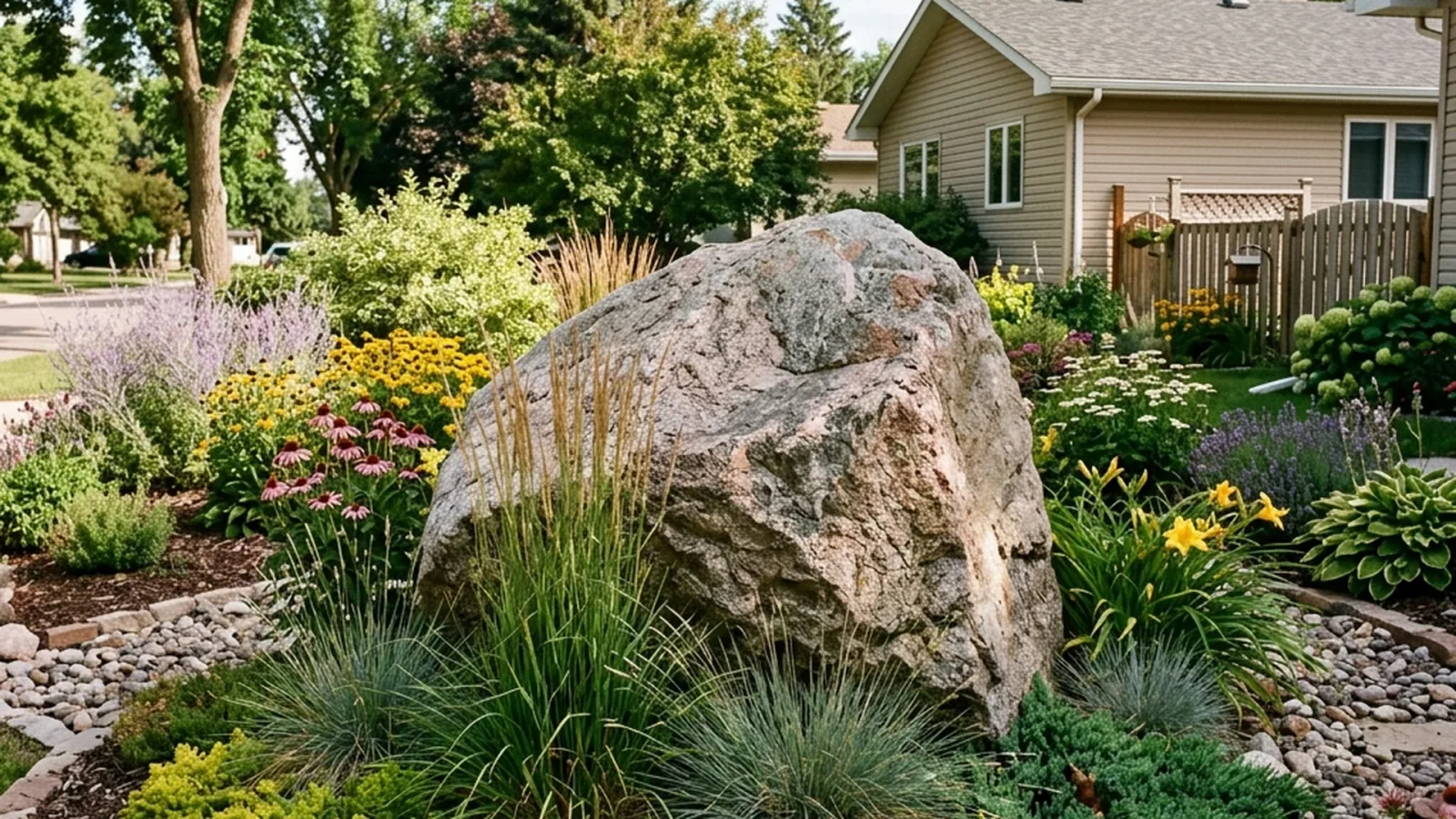
- Boulders are the largest-scale design element available in residential landscaping: a single well-placed boulder commands the visual weight of a mature tree without the maintenance
- In Winnipeg, boulder selection should account for freeze-thaw durability: granite and quartzite hold up better than softer sedimentary stone through temperature cycling
- Placement is the most skill-dependent part: a boulder buried one-third to one-half of its mass creates a natural, settled appearance; a boulder sitting on the soil surface looks placed, not native
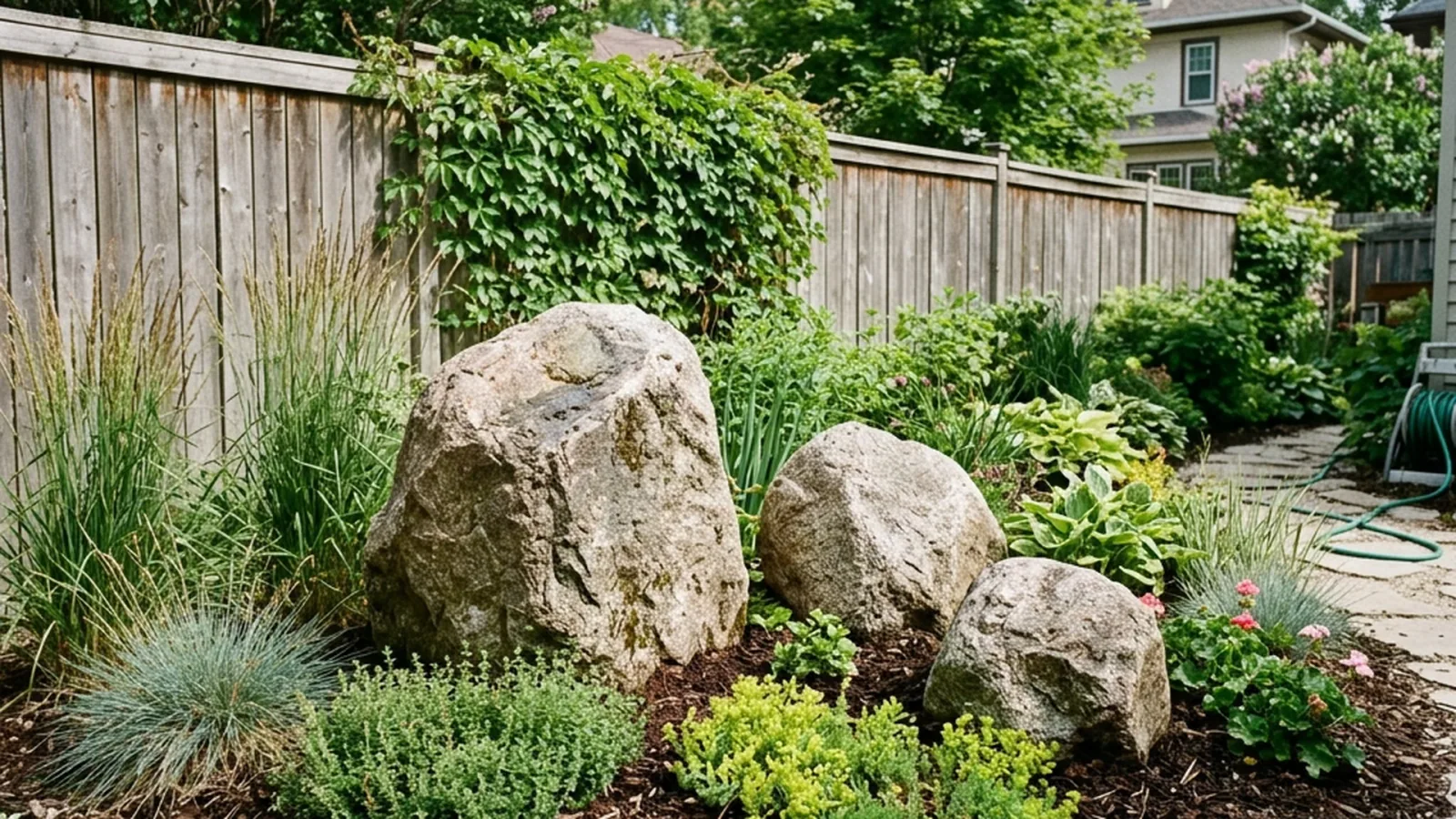
- Rock garden design around boulders uses the microclimate created by the stone, warmer on the south side, shaded and moister on the north, to plant species that complement the natural look
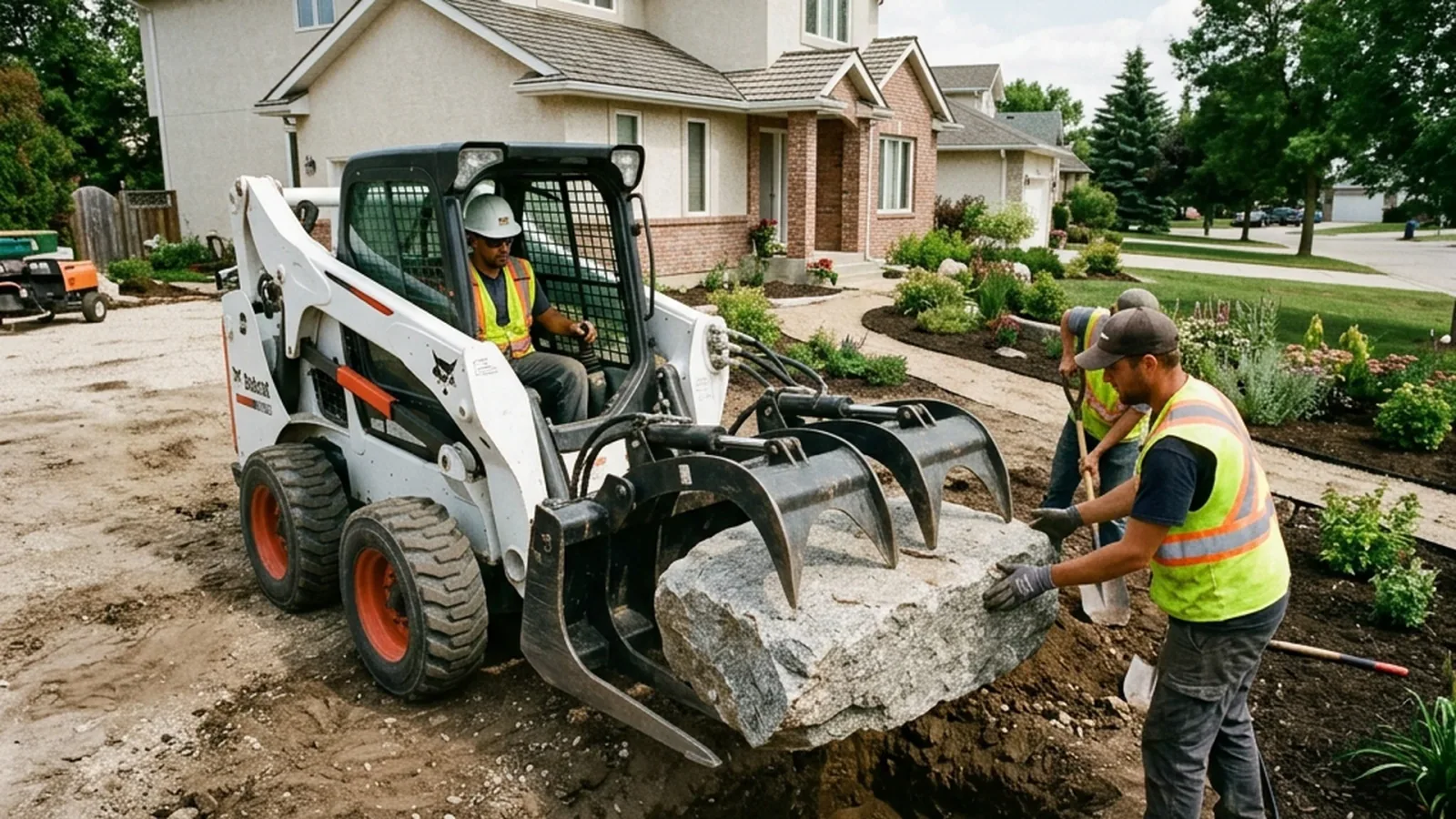
- Ditchfield delivers boulders by flatbed to Winnipeg properties; placement typically requires a skid steer or small crane depending on boulder mass
Why Boulders Work Differently Than Other Landscape Elements
A perennial bed, a hedge, or a patio all require years to reach their visual maturity. A well-placed boulder arrives mature. The visual weight, the sense of permanence, and the natural authority that a large stone brings to a landscape composition are immediate and do not diminish over time.
This makes boulders one of the most cost-effective elements available for creating a landscape that looks established quickly. A single 400 to 600 kg granite boulder, properly placed and planted around, anchors a garden bed in a way that no combination of smaller elements can replicate. It is also the element that most commonly separates landscapes that look designed from landscapes that look assembled.
Stone Type: What Performs Best in Winnipeg’s Climate
Not all stone behaves equally through Winnipeg’s freeze-thaw cycle. The key factor is porosity: stone that absorbs water and then freezes expands and can crack along existing fissure lines over time.
Granite (Most Durable)
The most durable choice for landscape boulders in Winnipeg. Extremely hard, essentially non-porous, and holds its surface and colour integrity through decades of freeze-thaw exposure. Colours range from warm pink and grey to charcoal, and the coarse crystalline texture reads as natural in a landscape setting. Granite boulders can be sourced in rounded fieldstone form or in more angular fractured forms depending on the design intent.
Quartzite
Shares granite’s hardness and durability, with a more layered visual texture. Colour range includes white, buff, pink, and multi-colour banded forms. An excellent choice for contemporary or naturalistic designs where a more linear, stratified stone appearance is part of the aesthetic intent.
Limestone
Common in Manitoba and provides a distinctive regional character. Softer than granite and more porous, meaning it weathers more visibly over time: edges soften, surface texture changes, and the appearance evolves over decades. This weathering is considered an asset in naturalistic designs. In very exposed or saturated sites, limestone may develop surface spalling over time in severe freeze-thaw conditions; for most residential placements it performs well.
Fieldstone and Rounded River Stone
Smoothed by glacial or water erosion, these provide the most natural, organic appearance in a landscape. Their irregular shapes and rounded profiles look most at home in naturalistic and prairie-garden designs. Available in a range of local and regional stone types.
The Rules of Boulder Placement
Placement is where boulder landscaping succeeds or fails, and it is the most commonly misunderstood aspect of the practice. A boulder sitting on the surface of the soil looks like something that was left there. A boulder with one-third to one-half of its mass buried looks like something that grew there.
The Burial Depth Rule: Every boulder in a naturalistic landscape should be buried to a depth of at least one-third, and ideally closer to one-half, of its visible height. For a 60 cm visible boulder, the excavation below the placement surface should be at least 20 to 30 cm deep. The burial also stabilizes the boulder: a stone buried at depth will not shift with frost movement the way a stone sitting on the surface will. Large boulders set shallowly in Winnipeg’s clay can heave several inches over a few freeze-thaw seasons, changing their angle and appearance over time.
Angle and Face Selection
Every boulder has a face: the side with the most visual interest, the most interesting texture or colour, or the most natural-looking profile. Before placement, the boulder should be examined on all sides to determine which face should be visible and which angle creates the most natural-looking composition. A boulder placed with its flattest, least-interesting face visible reads as a rock; a boulder placed with its most textured face visible at a slightly tilted angle reads as a landscape feature.
Groups and Composition
Single boulders are focal points. Groups of boulders create rock garden compositions. When grouping boulders:
- Odd numbers (3, 5, 7) create more natural-looking groupings than even numbers
- Vary sizes significantly within a group: one dominant boulder, one medium, one smaller creates a natural hierarchy
- Bury all members of a group, not just some: a partially buried group where some stones sit on the surface looks incomplete
- Orient the group’s axis at an angle to the house and property lines: alignment parallel to straight edges reads as placed, not natural
Rock Garden Design: Planting Around Boulders
A boulder placed without any associated planting is a stone. A boulder surrounded by appropriate planting that uses the microclimate created by the stone becomes a rock garden. Boulders create specific microenvironments that suit different plants than the surrounding garden.
South Side: Warm and Dry
The south-facing side absorbs heat and creates a warmer, drier microclimate. Right location for drought-tolerant, heat-loving species: sedums, creeping phlox, low-growing ornamental grasses, and alpine plants that appreciate the extra warmth.
North Side: Cool and Sheltered
Stays shaded through most of the day, retains moisture longer, and is sheltered from prevailing wind. This microclimate suits plants that appreciate cool, moist conditions: creeping Jenny, some fescues, and shade-tolerant groundcovers.
At the Base: Transition Zone
Planting at the base of a boulder, where soil meets stone, creates the visual transition that integrates the stone into the garden. Low, spreading plants that spill onto the stone surface are particularly effective: creeping phlox, alyssum, and spreading sedums.
Practical Considerations: Delivery and Placement in Winnipeg
Boulders are heavy. A 60 cm granite boulder weighs approximately 400 to 600 kg. A metre-diameter boulder weighs 1,000 to 1,500 kg or more. Placement requires equipment: a skid steer with appropriate forks or a grapple bucket is the standard tool for residential boulder placement. For very large boulders or for sites with access restrictions, a small crane or hiab may be needed.
Ditchfield delivers boulders to Winnipeg residential and commercial properties by flatbed. Confirm access for the delivery vehicle when ordering: narrow lots, gated properties, or sites with overhead obstructions affect delivery logistics. For boulders requiring professional placement with equipment, Lawn ‘N’ Order operates skid steer equipment and handles boulder placement as part of landscape builds across Winnipeg.
Sizing Guide and Cost Reference
| Boulder Dimension | Approx. Weight | Placement Equipment | Approx. Material Cost |
|---|---|---|---|
| 40 to 60 cm (15 to 24 in) | 150 to 400 kg | Hand placement for lighter; skid steer recommended | $150 to $500 per boulder |
| 60 to 90 cm (24 to 36 in) | 400 to 900 kg | Skid steer required | $400 to $1,000 per boulder |
| 90 to 120 cm (36 to 48 in) | 900 to 2,000 kg | Skid steer or small crane | $800 to $2,500 per boulder |
| 120 cm+ (48 in+) | 2,000 kg+ | Crane typically required | $2,000 to $8,000+ per boulder |
FAQ: Landscape Boulders in Winnipeg
Do boulders move with frost in Winnipeg?
Boulders set with adequate burial depth are highly resistant to frost movement. A boulder buried one-third to one-half of its mass is stabilized by its own weight and the compacted soil around its buried portion. A boulder sitting shallowly on the surface, with minimal burial, can shift with frost heave over time. The burial depth rule is also the frost stability rule.
Can boulders be placed in winter in Winnipeg?
Boulder delivery and placement can technically occur in winter, but excavating the placement hole to the required burial depth in frozen clay is significantly more difficult than in unfrozen soil. For most residential projects, spring through fall installation allows proper burial depth with standard equipment. For urgent installations or situations where the specific boulder is available only in winter, confirm equipment requirements with Ditchfield and the placement contractor.
What soil should I use to backfill around boulders?
Backfill around boulders in the placement hole should be a mixture of screened topsoil and the existing native soil, tamped firmly around the boulder to eliminate voids. Large voids left in the backfill create water pockets that freeze and can shift the boulder over time. For rock garden plantings around the boulder base, 4-way mix or a well-draining garden soil blend supports the drought-tolerant species that complement boulder placement.
Order Boulders at Ditchfield Supplies
Call 204-889-6268 or visit ditchfieldsoils.ca to discuss boulder inventory and delivery. Pickup at 2929 Sturgeon Road or flatbed delivery across Winnipeg. For full rock garden design and installation including boulder placement and planting, contact Lawn ‘N’ Order for a consultation.
Browse Products at Ditchfield
Call 204-889-6268