Quick Takeaways
- The drainage system behind a retaining wall is as structurally important as the wall itself: hydrostatic pressure from water-saturated clay is the most common cause of retaining wall failure in Winnipeg
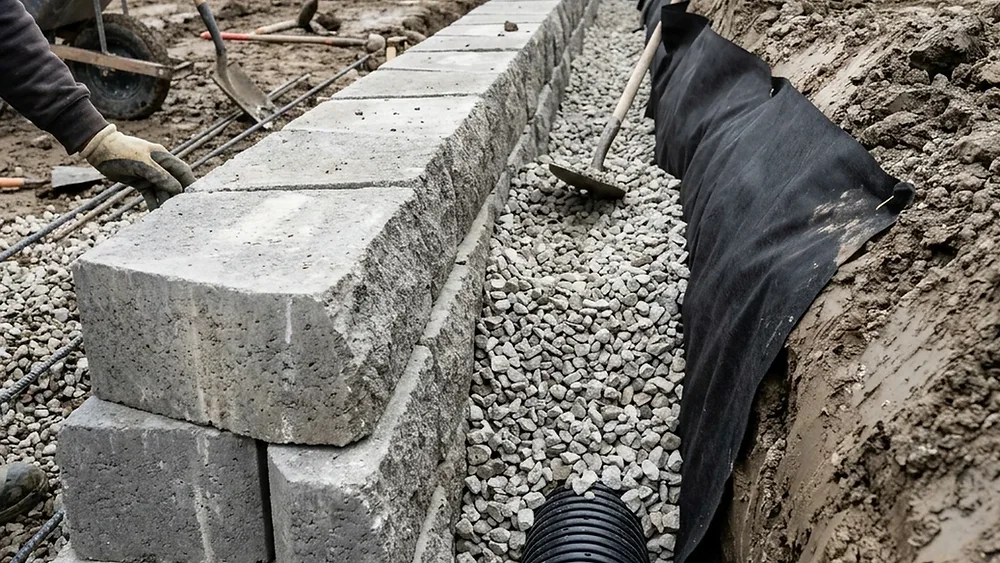
- A properly built wall drainage system has three components: granular backfill (drain rock), a geotextile fabric separator, and a perforated weeping tile pipe at the base routed to a daylight outlet
- The right drain rock for retaining wall applications is clean crushed limestone or washed gravel, 19 mm to 25 mm (3/4 to 1 inch) chip: angular, single-size, and free of fines
- Geotextile fabric separates the drain rock from the native clay, preventing clay migration into the drainage aggregate over time — a wall built without it will lose drainage function within 5 to 10 years
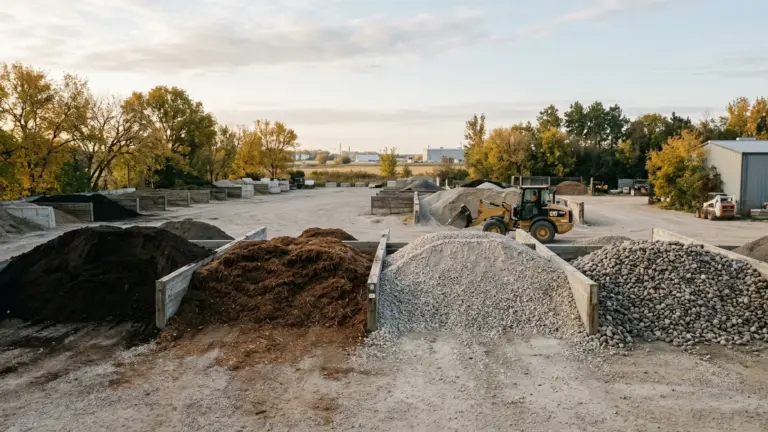
- Ditchfield supplies drain rock and geotextile fabric for retaining wall drainage systems; these are contractor-supply quantities available by the cubic yard. Weeping tile and perforated pipe are sourced separately at a plumbing or building supply
Why Most Retaining Wall Problems Start Behind the Wall
A retaining wall holds back soil. But what most homeowners and even some contractors underestimate is that soil is only part of what the wall is managing. In Winnipeg’s clay-heavy soil, a retaining wall is also managing water.
Red River clay absorbs moisture slowly and releases it slowly. After a significant rainfall or spring snowmelt, the clay behind a retaining wall can remain saturated for days. That saturated clay exerts hydrostatic pressure, the force of water pushing outward through the soil mass, against the back of the wall. A wall designed without drainage to relieve this pressure is fighting a losing battle: each wet season adds cumulative stress, and eventually the wall leans, tilts, or fails.
The drainage system behind the wall is not a nice-to-have. It is what allows the wall to function as designed across decades rather than years.
The Three-Component Drainage System
Component 1: Granular Backfill (Drain Rock)
The zone immediately behind the wall blocks, from the footing base to near the top of the wall, should be filled with clean granular material rather than the native clay that was excavated during wall construction. This granular zone serves two functions: it is structurally free-draining (water passes through it quickly rather than being held), and it provides a compaction-resistant backfill that reduces the lateral pressure exerted against the wall.
The right product is a clean crushed limestone or washed gravel in the 19 mm to 25 mm range (commonly called 3/4 inch or 1 inch chip). The specifications matter:
- Clean means essentially free of fines and dust. A product with significant fine particles will compact over time and lose drainage capacity.
- Single-size (uniform gradation) drains better than well-graded material, which tends to pack tightly.
- Angular crushed material holds position better than rounded pea gravel, particularly on the slope of a wall batter.
Do not use pea gravel, pit run, or screened gravel with high fines content. Do not use clean fill or topsoil as backfill behind a retaining wall: these materials hold water and increase pressure rather than relieving it.
Ditchfield supplies clean crushed limestone in 3/4 inch chip for retaining wall drainage applications. See ditchfieldsoils.ca/limestone-shale-sand or call 204-889-6268 to confirm current stock and arrange delivery.
Component 2: Geotextile Separator Fabric
Geotextile fabric (also called landscape fabric or filter fabric in a drainage context) is placed between the native clay soil and the drain rock backfill. Its function is to allow water to pass through while preventing clay particles from migrating into the granular backfill material.
Why this matters: without the fabric, clay particles from the native soil slowly work their way into the gaps of the drain rock over time, filling the pore space that makes the rock drain freely. A wall built without geotextile fabric may drain well in its first few years and lose drainage function progressively over 5 to 10 years as the clay-rock interface clogs. By the time drainage failure is visible as wall leaning or cracking, the remediation requires taking the wall apart.
Proper installation of geotextile fabric wraps the drain rock zone completely: fabric on the clay-facing side, fabric under the weeping tile, and fabric over the top of the drainage zone before the final native soil backfill continues. The fabric must not be installed between the wall blocks and the drain rock — the fabric goes between the drain rock and the clay, not between the drain rock and the wall.
Component 3: Weeping Tile at the Base
A perforated pipe (weeping tile) at the base of the drain rock zone collects water that has passed through the granular backfill and routes it to a daylight outlet away from the wall. Without the pipe, the drain rock eventually becomes saturated and loses its pressure-relief function.
The pipe should be:
- Perforated, with the perforations facing down to collect water from below rather than up to collect surface water.
- A minimum 100 mm (4 inch) diameter for residential retaining wall applications.
- Sloped at a minimum 1% grade toward the outlet (1 cm fall for every 1 m of run).
- Terminated at a daylight outlet, meaning the pipe exits to open air at a lower elevation than where it starts, not into a pop-up emitter that can freeze and block.
In Winnipeg’s clay soil, where drainage is already limited, a weeping tile outlet that freezes closed or is blocked prevents the drainage system from functioning through the spring thaw period, which is exactly when the hydrostatic pressure is greatest.
Volumes and Quantities
For contractors and homeowners planning material quantities, the following reference volumes apply for a standard retaining wall drainage installation:
| Wall Height | Drain Rock per Linear Foot (approx.) | Geotextile Width (approx.) | Weeping Tile |
|---|---|---|---|
| Up to 2 ft | 0.15 to 0.2 cubic yards per linear ft | 4 to 5 ft wide | 100 mm, single run |
| 2 to 4 ft | 0.25 to 0.4 cubic yards per linear ft | 5 to 6 ft wide | 100 mm, single run |
| 4 ft+ (engineered) | Engineering specification required | Engineering specification required | Engineering specification required |
These are reference quantities for planning purposes. Actual quantities depend on the depth of the excavation behind the wall, the native soil conditions, and the specific block system being used. For contractor bulk orders, call 204-889-6268 to discuss delivery scheduling for wall projects.
Common Installation Mistakes That Compromise Drainage
- Using native clay as backfill. Native clay re-excavated during wall construction should not go back behind the wall. It holds water and increases hydrostatic pressure. Use it for fill elsewhere on the property or dispose of it.
- Omitting geotextile fabric. The most common corner-cut in residential wall construction. The drain rock looks the same with or without it initially. The difference becomes apparent over 5 to 10 years as drainage function degrades.
- Installing fabric between blocks and drain rock. This is the wrong location. Fabric between the wall and the drain rock can prevent the drain rock from bearing against the wall properly and can trap water in the block cores.
- Routing weeping tile to a pop-up emitter in a lawn. Pop-up emitters freeze in Winnipeg winters and block during spring thaw, which is when drainage is most critical. Route to a true daylight outlet.
- Not connecting weeping tile to an outlet at all. A perforated pipe that terminates underground without an outlet is a collection point, not a drainage system.
The Relationship to Retaining Wall Post Topics
This guide covers the drainage materials that go behind the wall. For retaining wall product selection, including the specific Belgard and Barkman block options available through Ditchfield, see the retaining wall block comparison guide. For retaining wall design, engineering, installation, and cost in Winnipeg, see Lawn ‘N’ Order’s retaining walls guide.
FAQ: Drain Rock and Retaining Wall Drainage
How thick should the drain rock zone be behind a retaining wall?
A minimum of 12 inches (30 cm) of granular backfill measured from the back of the wall blocks is the standard for walls up to 4 feet. Taller walls or engineered walls may specify more. The drain rock zone should fill the full height of the wall, from the weeping tile at the base to within 12 inches of the top, where native soil backfill resumes.
Does every retaining wall need drainage?
In Winnipeg’s clay soil conditions, yes. A wall on a site with particularly free-draining sandy or gravelly native soil might manage without a full drainage system, but those site conditions are uncommon in most Winnipeg residential areas. The cost of drain rock, fabric, and weeping tile is small relative to the cost of a wall. The cost of rebuilding a wall that failed due to drainage omission is not small.
Can I use decorative rock instead of drain rock behind the wall?
No. Decorative rock and drain rock serve different functions. Decorative river stone or coloured granite used in surface applications is not specified for drainage applications. Drain rock needs to be angular, single-sized, and essentially free of fines. Decorative stone is often rounded, which allows it to pack too tightly for free drainage.
Order Drain Rock, Fabric, and Weeping Tile
Ditchfield supplies clean crushed limestone and geotextile separator fabric for retaining wall drainage systems. Perforated weeping tile is sourced at a plumbing or building supply store. Call 204-889-6268 or visit ditchfieldsoils.ca for product details and delivery. Contractor bulk orders available. Pickup at 2929 Sturgeon Road or delivery across Winnipeg.