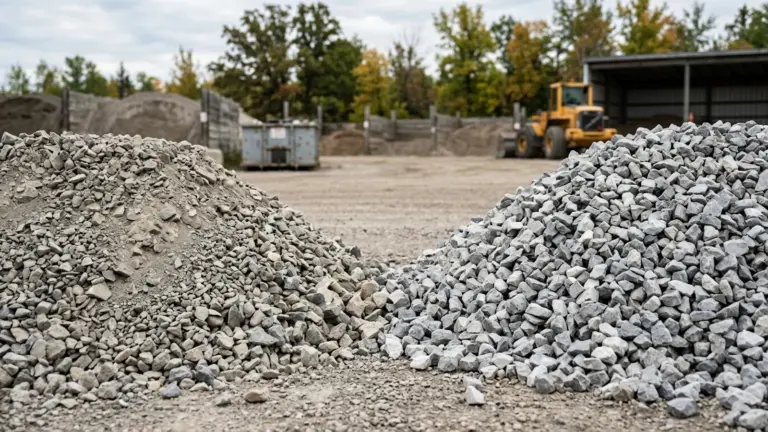
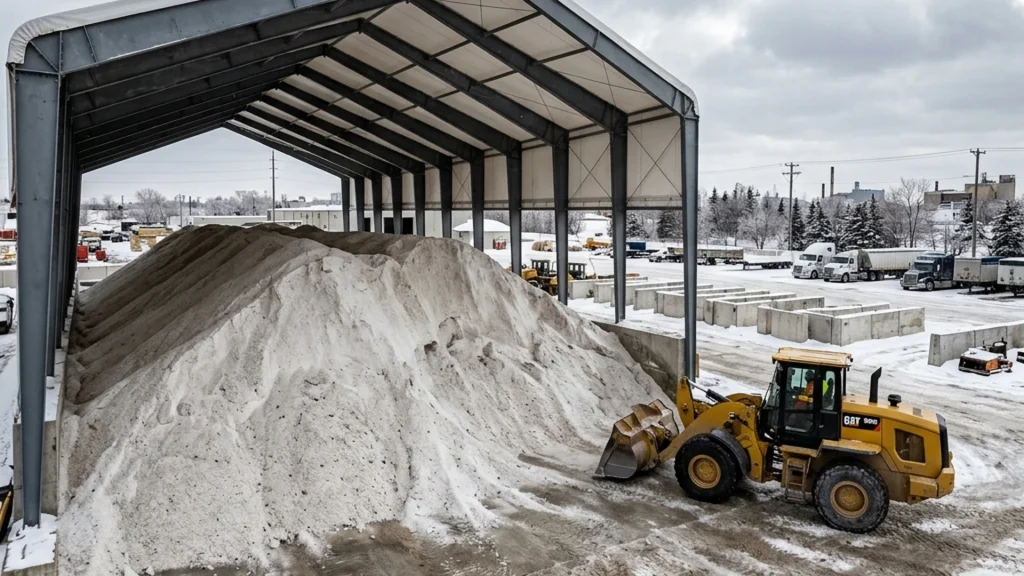
- Seasonal stocking for a commercial snow contract is a volume-planning problem: how much bulk salt and sand to have on hand before the season starts, not a single delivery decision made mid-storm
- Over-salting doesn’t improve melt performance beyond a certain point and has real costs: chloride runoff, corrosion of vehicles and metal building components, and long-term concrete surface damage from repeated freeze-thaw cycling in chloride-saturated concrete.
- A commonly used professional reference point for salt application is roughly 2.3 lbs per 1,000 sq ft at pavement temperatures around 30°F, scaling upward as temperatures drop. Use this as a planning baseline, not a fixed Manitoba regulation.
- Sand adds traction but does not melt ice; it’s a different tool for a different job than salt, and stocking plans should account for both separately.
- This guide covers seasonal volume planning for contractors; for material types and product basics, see our winter sand and ice control guide.
Stocking for a Season, Not a Storm
A commercial snow removal contractor managing multiple properties through a Winnipeg winter faces a planning problem that’s different from a homeowner buying a bag of ice melt as needed: how much bulk salt and sand does the season’s contracted properties actually require, and how does that translate into a stocking plan that avoids both running out mid-storm and over-ordering material that sits unused?
This guide is about that seasonal volume planning. For the material basics, what winter sand and salt products are available and how they’re typically used, see our winter sand and ice control guide, which this post won’t repeat.
Why Over-Salting Is a Real Cost, Not Just a Waste
The instinct on a busy commercial route is often to apply salt generously, on the theory that more salt means better melt and less callback risk. Beyond a certain application rate, additional salt doesn’t meaningfully improve melting performance, and it does create real, measurable costs.
Chloride Runoff
Chloride runoff into stormwater systems and adjacent green space is an environmental cost that increasingly shows up in municipal and property-level scrutiny of commercial snow operations.
Corrosion
Corrosion affects vehicles using the lot, metal railings, door frames, and other building components exposed to chloride-laden slush and splash.
Concrete Surface Damage
Chloride-saturated concrete is significantly more vulnerable to freeze-thaw spalling and scaling than concrete exposed to less chloride, which over multiple seasons can visibly deteriorate a parking lot or walkway surface the property owner is also paying to maintain.
None of this means using less salt than a job requires; under-salting creates real slip-and-fall liability exposure, which is its own serious cost. The point is that application rate has a right-sized target, and both under- and over-application carry real costs in different directions.
A Professional Reference Point for Application Rates
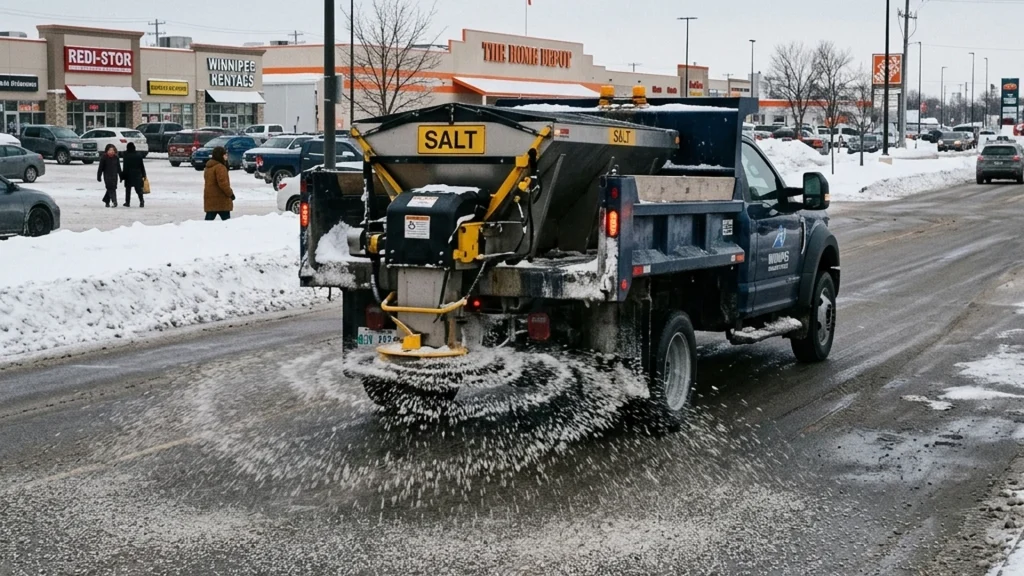
Established North American deicing guidance, developed through programs like the Wisconsin and Minnesota salt-smart initiatives that study parking lot and roadway application rates, offers a commonly used reference: approximately 2.3 lbs of salt per 1,000 square feet at a pavement temperature around -1°C (30°F) for typical light snow or icing conditions, scaling upward as pavement temperature drops, since salt’s melting effectiveness decreases in colder conditions.
| Pavement Temperature | General Application Guidance |
|---|---|
| Around -1°C (30°F) | Lower end of the range; roughly 2.3 lbs/1,000 sq ft as a starting reference |
| -4 to -2°C (mid-20s°F) | Moderately higher; effectiveness begins declining, more material typically needed. |
| Below -9°C (15°F) | Salt effectiveness drops significantly; some professional guidance recommends against straight rock salt below this range in favour of blended products or spot treatment. |
This table reflects general professional deicing guidance developed primarily from U.S. Midwest programs, not a Manitoba-specific regulatory standard. Use it as a planning reference and a sense check against your own operation’s application rates, not a fixed rule; actual optimal rates depend on your specific equipment calibration, product type (straight rock salt vs. pre-wetted or blended products), and site conditions. A properly calibrated spreader and a documented target rate per property are what actually control cost and effectiveness season over season, more than any single reference number.
Estimating Seasonal Volume
Working backward from a target application rate to a seasonal stocking volume requires a few inputs specific to your operation:
Total square footage across all contracted properties requiring salt application
Average number of salt application events per season based on historical Winnipeg winter patterns (this varies significantly year to year, so use a multi-year average where you have the data rather than a single season)
Your target application rate per event, informed by the reference table above and your own operational experience
A reasonable buffer for a heavier-than-average winter, since running out of stock mid-season and needing an emergency reorder is generally more expensive and riskier than carrying modest surplus into spring.
Build in a buffer, commonly 15 to 25 percent above the calculated baseline, for a season with more events than average.
Sand: A Different Tool, A Separate Stocking Decision
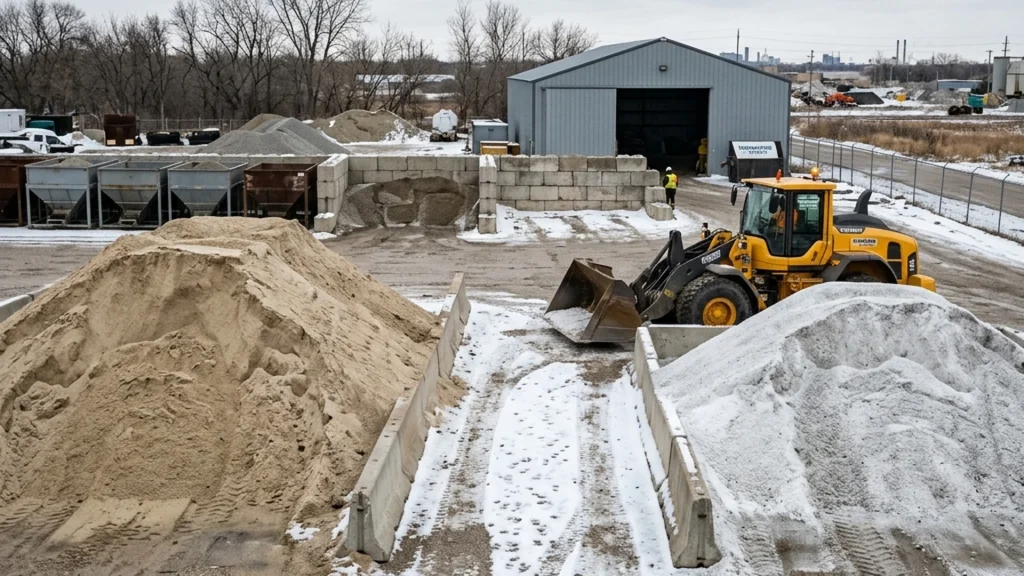
Sand provides traction on packed snow and ice; it does not melt ice or snow the way salt does. Many commercial operations use sand and salt together, or sand alone in very cold conditions where salt’s melting effectiveness has dropped significantly, but the two materials serve different functions and should be planned as separate line items in a seasonal stocking plan rather than a single combined estimate.
Sand volume planning follows a similar square-footage-based approach to salt, but the application rate and the conditions that trigger sand use (very cold temperatures where salt effectiveness drops, or areas where a purely mechanical traction aid is preferred over a chemical deicer) differ from salt’s triggers. Track sand and salt usage separately through the season if you’re refining your stocking plan year over year.
Bulk Delivery and Storage for Contractors
For commercial-scale seasonal volumes, bulk delivery is more practical and cost-effective than repeated bagged purchases through the season. Confirm storage conditions before committing to a full-season bulk order: bulk salt needs to be stored covered and, ideally, on a surface that prevents ground contact moisture from causing the pile to cake or clump, which makes it harder to load and spread consistently through the season.
Ditchfield supplies traction sand, salt and sand blends, and ice control materials for commercial contractors. Call 204-889-6268 to confirm current product availability, including straight bulk rock salt, and to discuss seasonal volume planning, delivery scheduling across the winter, and storage logistics for your specific operation. For product types and basic winter material information, see our winter sand and ice control guide.
FAQ: Bulk Salt and Sand for Commercial Contracts
How much should I buffer above my calculated seasonal estimate?
A 15 to 25 percent buffer above your calculated baseline is a common approach, adjusted based on your operation’s risk tolerance and how confident you are in your historical application-event data. An operation with several years of consistent tracking data can run a tighter buffer than one estimating with limited history. Running out mid-season, particularly during a major event when demand across all suppliers spikes simultaneously, is generally the costlier failure mode compared to carrying modest surplus.
Is pre-wetted or blended salt worth the extra cost over straight rock salt?
Pre-wetted and blended products generally allow effective melting at lower application rates and can work at lower temperatures than straight rock salt, which can offset some or all of the higher per-tonne cost through reduced volume needed and better performance in genuinely cold conditions. Whether the tradeoff makes sense for your operation depends on your typical temperature range, application volume, and equipment; discuss current product options and pricing with the Ditchfield team.
Can I store bulk salt outdoors uncovered through the season?
Uncovered outdoor storage exposes the pile to precipitation, which causes caking, clumping, and material loss through runoff, in addition to environmental concerns about uncontrolled chloride runoff from an exposed pile. Covered storage, or storage under a proper salt dome or shelter, is the standard recommended approach for maintaining material quality and controlling runoff through a full season.
Plan Your Season’s Bulk Salt and Sand
Ditchfield supplies traction sand, salt and sand blends, and ice control materials for commercial snow and ice contracts across Winnipeg. Call to confirm current product availability for your operation and to discuss seasonal volume planning and delivery scheduling before the season starts. Pickup at 2929 Sturgeon Road or delivery across Winnipeg.
Browse Winter Materials
Call 204-889-6268