Quick Takeaways
- Limestone screenings (stone dust) are the compacted base and sub-base material of choice for interlocking paver projects in Winnipeg — angular, self-compacting, and structurally stable through freeze-thaw cycles.
- Current CMHA best practice specifies washed concrete sand for the paver setting bed — the thin layer immediately below the paver — not screenings.
- Screenings in the setting bed hold fines and moisture that can cause problems; the distinction between base material and bedding course is the most important technical decision in paver installation.
- Contractors order screenings by the tonne or cubic yard for base compaction and use a separate concrete sand product for the bedding course
- Ditchfield supplies limestone screenings for paver base work; call 204-889-6268 to confirm current product availability and arrange contractor quantities
What Screenings Are and Where They Come From
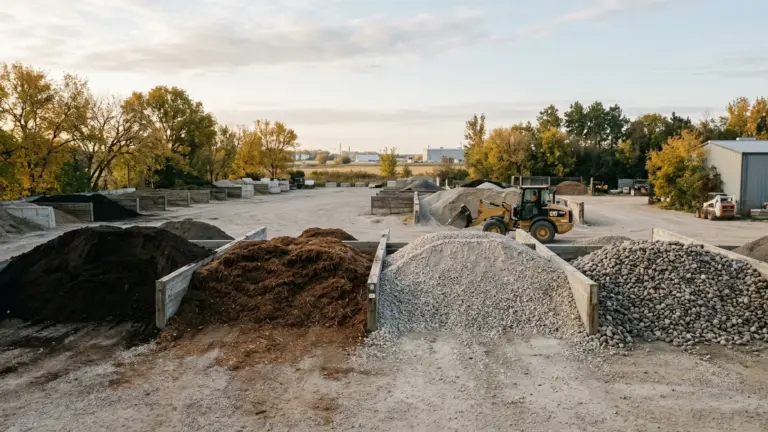
Limestone screenings — often called stone dust, chip stone, or crusher fines — are the fine byproduct of crushing limestone to produce larger aggregate products. When limestone is crushed to produce 3/4 inch chip or larger products, the particles smaller than approximately 5 mm are separated and sold as screenings. The material ranges from very fine dust to 5 mm particles with a high proportion of angular edges.
That angularity is what makes screenings useful for paver base work. Angular particles interlock when compacted: they do not roll or shift past each other the way rounded particles do. A compacted layer of limestone screenings creates a semi-rigid interlocked mass that resists lateral movement, which is exactly the behaviour needed in a paver sub-base material.
The Technical Distinction: Base Material vs Setting Bed
This is the most important technical point in this guide, and it is where imprecise advice creates problems in paver installations.
A standard interlocking paver installation has multiple layers:
- Subgrade: native soil, graded to drain and compacted as base of the system
- Sub-base: compacted granular material, typically 100 to 150 mm deep for residential applications, providing structural support and drainage
- Base: a second compacted granular layer directly below the bedding course, approximately 50 mm deep
- Bedding course (setting bed): the thin, uncompacted layer, approximately 25 to 30 mm deep, on which pavers are set and levelled
- Pavers: set on the bedding course and compacted into final position
Where Screenings Belong
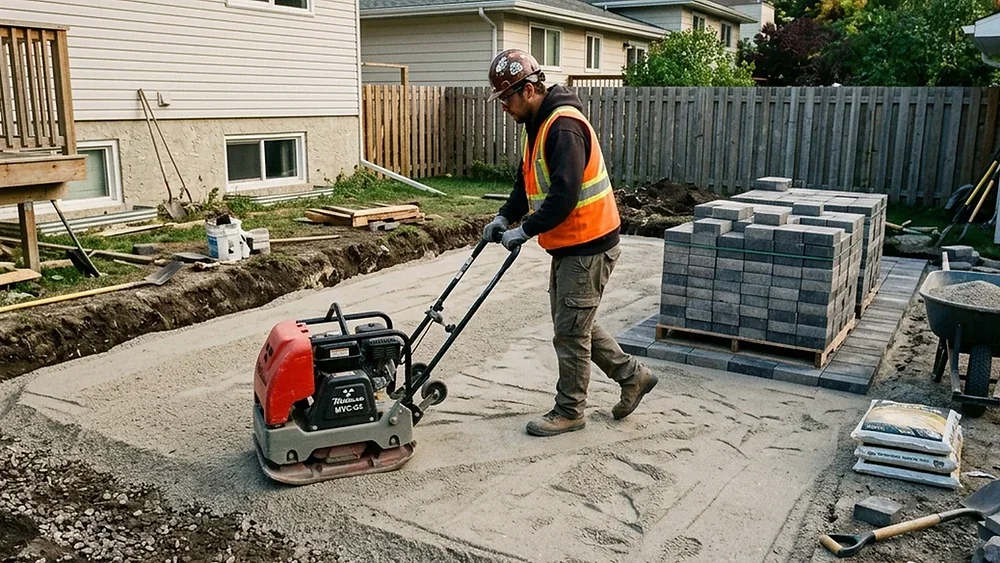
Limestone screenings are the right material for the sub-base and base layers. Their angular, self-compacting properties make them ideal for the structural layers that must resist settlement, frost heave, and lateral movement. Contractors compact screenings in lifts using a plate compactor, creating a dense, stable base for the paver surface.
Where Screenings Should Not Be Used
The ICPI standard specifies washed concrete sand for the bedding course, not screenings. The reason is the fine content: screenings contain a significant proportion of dust-size particles that hold moisture and compact under load. In the setting bed, which is intentionally left uncompacted to allow fine grading of the paver surface, screenings can:
- Compact unevenly under paver load, creating surface waviness over time
- Hold moisture against the paver base and in the joint system, potentially contributing to freeze-thaw instability in the setting course.
- Wash away more readily than coarser sand during rain events on freshly laid work.
Washed concrete sand in the 0 to 5 mm range, free of excessive fines, is the specified setting bed material because it holds a screed, allows even paver placement, and settles consistently under compaction without the moisture-retention issues of fine-heavy screenings.
This is an area where long-standing Winnipeg contractor practice has sometimes differed from the ICPI standard: screenings have been used as a combined base-and-bedding material for decades here. The result is functional in many cases, but technically not the specified approach, and the distinction matters on projects where long-term surface stability is a priority.
Screenings in Winnipeg’s Freeze-Thaw Context
Winnipeg’s 60-plus freeze-thaw cycles per year put more stress on a paver base system than most North American markets. The base material’s ability to shed water and resist frost heave is the critical performance factor.
Limestone screenings compact to a dense, relatively impermeable layer, which means water that enters the base through the joints needs a clear path to the perimeter drainage rather than draining downward through the base itself. Good edge drainage design is more important with screenings as base material than with open-graded aggregate, which drains freely through the entire base profile.
For Winnipeg installations, the standard approach: compact screenings as the structural base, ensure the finished base slopes slightly toward the perimeter for drainage, and install perimeter edge drainage where the site conditions hold water. Do not allow water to pond on a paver surface over the screenings base without a drainage outlet, as repeated freeze-thaw of trapped water in the system is the primary cause of premature paver heaving in this climate.
What Contractors Order and in What Quantities
A standard residential patio installation on a Winnipeg property requires:
| Material | Purpose | Approximate Quantity (per 10 sq m of patio) |
|---|---|---|
| Limestone screenings | Sub-base and base compaction layers | 1.5 to 2.5 tonnes (150mm depth compacted) |
| Washed concrete sand | Bedding course (setting bed) | 0.3 to 0.4 tonnes (30mm uncompacted) |
| Geotextile fabric (optional) | Separator below screenings on poor soil | As required by site conditions |
These quantities assume a standard residential installation depth of 150 mm of compacted screenings base plus a 30 mm bedding course. Projects with poor subgrade conditions, higher traffic loads, or engineered specifications may require additional depth.
Contractors ordering for multiple projects or large patio builds can arrange staged delivery scheduling with Ditchfield to coordinate material arrival with project phases.
Call 204-889-6268 or visit ditchfieldsoils.ca/limestone-shale-sand for current product availability and pricing. Pickup at 2929 Sturgeon Road or delivery across Winnipeg. For washed concrete sand for the bedding course, confirm availability when ordering — it is stocked alongside the screening products.
FAQ: Screenings and Stone Dust for Paver Work
Can I use the same screenings for both the base and the bedding course?
Many contractors do, and it produces functional results in a lot of installations. But the ICPI specification is washed concrete sand for the bedding course, not screenings. For a residential patio where long-term surface stability is the goal, separating the materials is the better practice: screenings for the compacted base layers, washed concrete sand for the 30mm setting bed. The additional material cost is minimal, and the technical justification is sound.
What is the difference between screenings and clear stone for drainage?
Screenings are fines-rich and compactable — right for base layers that need structural stability. Clear stone (single-size, clean crushed rock with fines removed) is free-draining — right for drainage applications like retaining wall backfill, French drains, and drainage courses where water needs to pass through the material quickly. The two products serve opposite functions. Do not use screenings where clear stone is specified and vice versa.
How deep should the screenings base be for a Winnipeg patio?
For a residential patio with pedestrian traffic only, a minimum of 100 mm (4 inches) of compacted screenings over stable subgrade is the starting point. In Winnipeg, where freeze-thaw depth means the base experiences real seasonal movement, 150 mm (6 inches) is a more conservative and commonly used depth. Driveways and areas with vehicle traffic require deeper engineered bases. Compact in lifts no thicker than 100 mm each, as a single thick lift will not compact uniformly.
Order Limestone Screenings at Ditchfield
Ditchfield supplies limestone screenings for paver base work in contractor quantities. Call 204-889-6268 or visit ditchfieldsoils.ca for current stock and delivery. Pickup at 2929 Sturgeon Road or delivery across Winnipeg. For paver installation services, Lawn ‘N’ Order installs interlocking patio and walkway systems across Winnipeg.