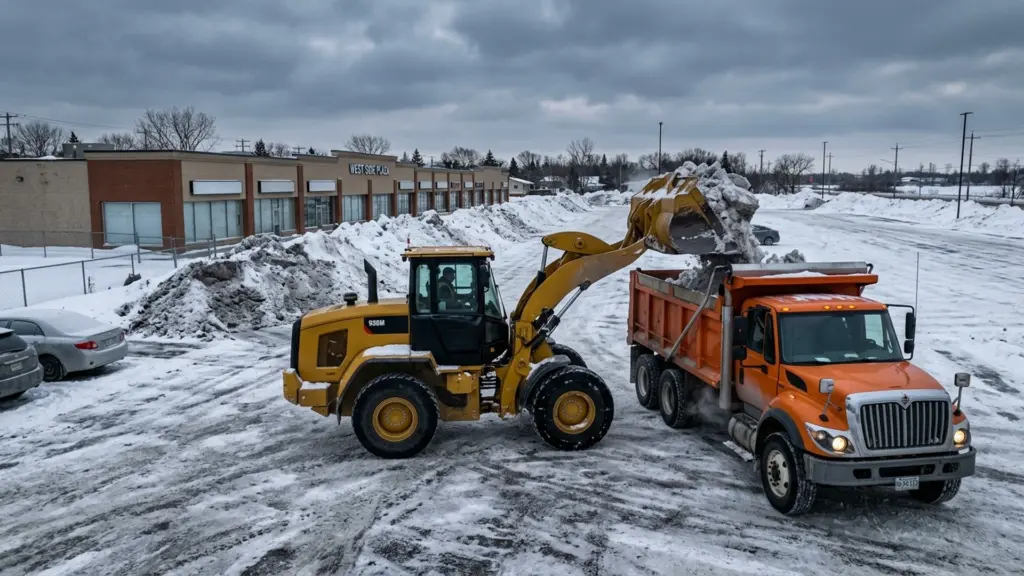
Clearing moves snow away from entrances, parking stalls, and drive aisles, but it still leaves the snow somewhere on the property. When those storage areas begin to fill up, commercial snow hauling may be needed to remove accumulated piles from the site.
For Winnipeg property managers, the decision is usually based on usable space, visibility, access and changing weather conditions. This guide explains the signs that a commercial snow pile has become an operational problem, what happens during a hauling assessment and which site conditions can affect the work.
Snow clearing and snow hauling solve different problems
Snow clearing keeps active areas usable by moving snow to a designated storage area on the property. Snow hauling removes accumulated piles from the property when on-site storage is no longer practical.
A site may need both services during the same winter. Routine clearing can manage individual snowfalls, while hauling may be arranged later in the season to recover parking and access space. Ditchfield provides commercial snow removal and snowbank hauling, subject to the property, equipment requirements, current conditions and scheduling availability.
Signs that a commercial snow pile may need to be hauled away
Parking capacity is being reduced
Snow piles often begin in perimeter stalls or other low-traffic areas. As more snow is added, the footprint expands and additional parking spaces may become unusable. For a retail, office or multi-tenant property, lost parking capacity can affect customers, employees and daily operations.
A useful way to monitor this is to record how many stalls are unavailable after each major clearing event. If the number continues to grow and there is no practical area where the pile can be pushed farther back, hauling may be the better option.
Sightlines are being obstructed
Snowbanks near driveways, internal intersections and pedestrian crossings can restrict visibility. Drivers may have difficulty seeing approaching vehicles or pedestrians, especially when pulling out from behind a tall pile.
Visibility concerns should be assessed based on the actual traffic pattern of the property. A pile that is acceptable in an unused corner may create a different level of concern beside a busy exit or walkway.
Drive aisles or loading areas are becoming narrower
Repeated clearing can gradually push pile edges into drive aisles, loading zones, waste collection areas and service access routes. This can make turning and manoeuvring more difficult for delivery vehicles, snow equipment and emergency access.
Property managers should pay particular attention to loading docks, fire routes, overhead restrictions and areas where trucks need sufficient turning room.
The site has no practical room for the next snowfall
Hauling does not need to wait until every available storage area is full. If another significant snowfall would leave the clearing crew without a safe or practical place to put the snow, arranging removal in advance can make the next service easier to manage.
A thaw could create drainage or refreezing concerns
Large piles can release a concentrated amount of meltwater during a warm period. Site grading, drains, shaded areas and overnight temperatures all affect what happens next. Where meltwater is likely to collect and refreeze in active areas, removing selected piles before a thaw may reduce the volume left to manage on site.
How a commercial snow hauling request is assessed
Snow hauling is site-specific. Before confirming the work, the team needs enough information to understand the pile, equipment access, loading area, destination and requested timing.
Useful information includes:
- the property address and site contact;
- photos of the current snow piles and surrounding work area;
- the approximate number, size and location of the piles;
- entrance widths, turning space and overhead restrictions;
- areas that must remain open during the work;
- the preferred timing and any operating-hour restrictions.
Depending on the site and accumulated volume, the work may involve loader equipment and one or more trucks. Compacted or partially frozen piles can also require a different approach from recently accumulated snow. Ditchfield reviews these details before confirming the available equipment and scope.
What affects the scope and scheduling?
Accumulated snow volume
The amount of snow on site affects the expected loader time and number of truckloads. Photographs are helpful for an initial discussion, but an assessment may still be needed before the work can be confirmed.
Pile condition
Freshly accumulated snow, compacted snowbanks and piles that have gone through repeated melt-and-refreeze cycles do not handle the same way. Dense or frozen material may take more time to break apart and load.
Site access
Entrance width, turning room, parked vehicles, loading areas, overhead wires and nearby structures can affect which equipment is suitable. Clear site photos and access measurements help identify possible restrictions before scheduling.
Hauling distance and destination
Travel time between the property and the appropriate disposal destination affects each hauling cycle. The suitable destination and job details should be confirmed as part of the assessment rather than assumed from a fixed online estimate.
Weather and existing bookings
Availability can change during active winter weather. A widespread snowfall may increase demand for loaders and trucks across Winnipeg, so a property that regularly runs out of snow-storage space should discuss the likely need before it becomes an emergency.
Partial hauling can solve the immediate problem
Not every pile needs to leave the property. In many cases, the practical approach is to prioritize the piles creating the greatest operational impact. That may mean recovering prime parking stalls, reopening a loading area or improving visibility at an exit while leaving snow in genuinely out-of-the-way storage areas.
Sharing the priority areas with the hauling team helps focus the assessment on the result the property needs rather than assuming complete removal is required.
Plan hauling alongside the rest of the winter operation
Hauling is one part of a commercial winter plan. Parking-lot clearing, snow relocation, traction materials and ice control address different site conditions. Contractors planning material requirements can also review Ditchfield’s guide to bulk salt and sand for commercial snow contracts.
If the property also requires material hauling or loader support outside the winter season, see Ditchfield’s hauling and loader work information.
Frequently asked questions
How do I know whether to push a pile back or have it hauled away?
Pushing a pile back is useful when it creates meaningful additional storage without affecting access, visibility or drainage. Hauling becomes more relevant when repositioning no longer recovers usable space or simply moves the same problem closer to another active area.
Can snow hauling be arranged before the site is completely full?
Yes. A property can request an assessment before storage space is exhausted, particularly if another snowfall or a significant thaw is expected. Equipment and scheduling availability vary, so timing must be confirmed directly.
Does all the accumulated snow need to be removed?
No. Partial hauling may be appropriate when only certain piles are reducing parking, obstructing sightlines or interfering with loading and access. The priority areas should be identified during the assessment.
What should I send when requesting an assessment?
Send the property address, current photos, approximate pile locations, access restrictions, priority work areas and preferred timing. These details help the team assess the likely equipment and hauling requirements.
Does Ditchfield provide residential snow removal?
Ditchfield focuses on commercial loader work, parking-lot clearing and snow hauling. Residential snow-removal requests are handled by its snow-removal partner, Lawn N Order.
Request a commercial snow hauling assessment
If snow piles are reducing usable space or creating access concerns on a commercial property, contact Ditchfield Supplies with the location, photos and preferred timing. You can also call 204-889-6268. Service scope and availability are confirmed after the site details have been reviewed.