Quick Takeaways
- Interlocking pavers are a flexible system that handles freeze-thaw cycles far better than rigid concrete slabs
- Proper base preparation (6-8″ compacted granular base in Manitoba) determines long-term performance
- Most heaving and settling issues aren’t caused by pavers; they’re caused by inadequate excavation or base compaction
- Individual stones can be replaced without redoing the entire surface
- Paver driveways can increase home value by $10,000-$20,000
Drive through any established Winnipeg neighbourhood, and you’ll see the evidence: cracked concrete driveways, heaved sidewalks, patios with spiderweb fractures spreading across the surface. Our climate destroys rigid surfaces.
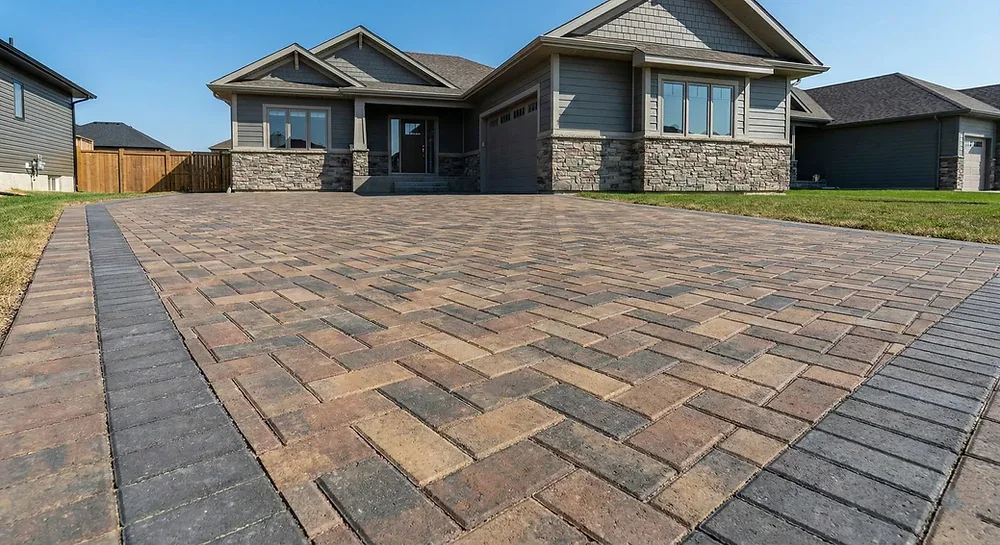
Paving stones Winnipeg homeowners are choosing offer something concrete cannot: a flexible installation system. Interlocking pavers move with the ground during freeze-thaw cycles instead of cracking under pressure. They handle our extreme temperature swings, shed ice and snow effectively, and look better doing it.
Why Pavers Outperform Concrete in Winnipeg’s Climate
The Real Advantage: A Flexible Installation System
The real performance advantage of pavers isn’t just the material itself; it’s the installation system. Unlike poured concrete, which is a single rigid slab prone to cracking when the ground shifts, pavers are installed as a flexible system that can move slightly with seasonal expansion and contraction.
Poured concrete is rigid. When frost heaves the soil beneath it, concrete has nowhere to go but up, cracking and breaking in the process. Interlocking pavers shift as individual units, absorbing ground movement through the sand joints between them. When spring arrives and the ground settles, the pavers settle back into place. The result is a surface that can last 30 years or more without structural failure.
This flexibility is critical in a market like Winnipeg, where temperature swings are extreme, from -40°C winters to +35°C summers. That’s a 75-degree temperature range your hardscape needs to survive, year after year.
Curb Appeal and Property Value
First impressions matter. According to industry surveys, 84% of homebuyers wouldn’t consider a house without a paved driveway. A well-maintained paver driveway can increase a home’s resale value by $10,000 to $20,000.
Beyond the numbers, paving stones simply look better than concrete. The variety of colours, patterns, and textures available means you can create a surface that complements your home’s architecture and stands out from every other house on the street.
What Types of Paving Stones Are Available?
Concrete Pavers: The Most Popular Choice
Concrete pavers dominate the market for good reasons. Made from cement and aggregate under high pressure, they’re extremely durable, weather-resistant, and available in countless shapes, sizes, and colours. Modern manufacturing allows concrete pavers to replicate the appearance of natural stone, brick, or slate at a fraction of the cost—and they’re easy to replace if individual pavers become damaged.
At Ditchfield, we carry two leading concrete paver brands: Belgard and Barkman—both engineered specifically for Canadian freeze-thaw conditions. For architectural-grade options, Techo-Bloc offers premium features like colour-through construction, deicing salt resistance, and lifetime transferable warranties.
Classic Styles: Holland and Cobble
Holland pavers are the workhorse of the paver world—simple rectangular units that create clean, timeless surfaces. Available in multiple sizes (8×4, 8×8), they work for everything from driveways to patios and walkways. Their straightforward shape makes installation efficient and repairs simple.
Cobble pavers (including Belgian Cobble) offer an old-world aesthetic with tumbled edges and varied sizing that mimics historic European streetscapes. They’re ideal for creating warm, inviting surfaces with character and charm.
Modern Styles: Hexagon, Broadway, and Origins
Hexagon pavers bring contemporary geometric design to outdoor spaces. Available in full hexagon and half-hexagon shapes, they create striking patterns that stand out from traditional rectangular layouts.
Broadway series (available in 65mm and 100mm thicknesses, plus Planks, Weathered, and Contour variations) offers linear, modern aesthetics with plank-style proportions. The Weathered finish adds an aged look while maintaining structural integrity.
Origins series from Belgard (including the new Antiqued finish for 2025) provides versatile multi-piece systems that create organic, random patterns with a single product line.
Natural Stone Look: Flagstone-Style Pavers
Want the look of natural flagstone without the inconsistency of natural stone? Both Belgard and Barkman offer flagstone-style pavers—manufactured concrete pavers designed to mimic the organic appearance of natural flagstone while providing the durability and consistency of engineered products. Barkman’s Mesa Flagstone offers another variation with slightly different texture. You get the character and texture of natural stone with the freeze-thaw performance and uniform thickness that makes installation easier and long-term performance more reliable.
Specialty Options: Circle Kits and Permeable Pavers
Circle kits (like Barkman’s Roman Circle Kit) provide pre-measured paver sets for creating circular focal points—perfect for fire pit surrounds, garden centrepieces, or decorative patio accents. The kits take the guesswork out of cutting and fitting curved patterns.
Permeable pavers (like Belgard Turfstone) allow water to infiltrate through the surface rather than running off. These eco-friendly options help manage stormwater, reduce runoff, and help meet municipal drainage requirements. Turfstone’s grid pattern also allows grass to grow through, creating a green driveway or parking area that’s still structurally sound for vehicle traffic.
Porcelain Pavers: Premium Aesthetics and Performance
Porcelain pavers represent the premium end of the market. Brands like Enmon Porcelaine offer exceptional stain resistance, consistent colouring, and a refined appearance that mimics natural stone or contemporary concrete finishes.
Porcelain is lighter than concrete or natural stone, making installation more manageable. It’s also extremely hard and dense—highly resistant to scratches, stains, and fading. The low porosity means water doesn’t penetrate, which improves freeze-thaw performance. Available in 2cm thicknesses for patios and walkways, and 3cm for driveways.
Base Materials: Limestone Aggregate
The pavers you see are only half the story—what’s underneath determines whether they last 5 years or 30. We carry limestone aggregate products specifically designed for paver base applications:
Limestone Base Materials:
How Do Interlocking Pavers Work?
The Sand-Set System Explained
Interlocking pavers rely on a sand-set system rather than mortar or adhesive. The installation starts with a compacted gravel base, followed by a layer of bedding sand. Pavers are placed on the sand and packed tightly together. Finally, polymeric sand is swept into the joints and activated with water.
This system allows individual pavers to move independently while maintaining a cohesive surface. The sand joints flex under load and temperature changes, distributing stress across the entire surface rather than concentrating it at weak points.
Why Flexibility Prevents Cracking
Think of a paver surface as a flexible shell rather than a rigid slab. When frost heaves the base, pavers can shift slightly without breaking. When heavy loads drive over them, the weight distributes across multiple pavers rather than stressing a single point.
This flexibility also means pavers can be installed over areas with minor settling issues. The surface will adjust to match the base rather than cracking under tension. And if settling does occur years later, individual pavers can be lifted, the base re-levelled, and the same pavers reset—try that with concrete.
Pavers vs. Poured Concrete vs. Asphalt: Which Lasts Longer?
While pavers cost more upfront, the combination of longevity, low maintenance, and easy repairs makes them the most economical choice over time. You won’t pay for repaving every decade, and small repairs don’t require tearing out the entire surface.
What Can You Build with Paving Stones?
Driveways, Patios, Walkways, Pool Decks
Paving stones suit virtually any outdoor hardscape application. Driveways benefit from pavers’ load-bearing capacity and durability. Patios gain aesthetic appeal and slip resistance. Walkways become permanent paths that won’t crack or heave. Pool decks stay cooler than concrete and drain effectively.
The design possibilities are endless. Mix paver colours to create borders and patterns. Use different sizes to add visual interest. Combine rectangular pavers with hexagon accents or add a circle kit focal point around your fire pit.
Manitoba Standards vs. Warmer Climate Shortcuts
Here’s what separates quality paver installations from failures: the base. Most heaving, settling, or shifting issues aren’t caused by the pavers—they’re caused by inadequate excavation or base compaction.
Some landscapers suggest 4-6″ of base, but that’s more suitable for warmer, year-round climates with minimal frost movement. In Manitoba, frost penetrates deep into our soil. Without adequate base depth, even quality pavers will shift and heave within a few seasons.
Installation: Getting the Base Right
A proper Manitoba installation includes:
- Excavating 8-12″ deep to remove unstable soil and organic material
- Installing 6-8″ of granular base material (like 3/4 Down Limestone), compacted in 2″ lifts
- Adding 1″ of levelling sand
- Placing pavers in the desired pattern with proper edge restraints
- Filling joints with polymeric sand
Using quality landscape fabric and edging prevents weed growth and keeps pavers from shifting outward over time. Cutting corners on base materials or edge restraints leads to uneven surfaces and premature failure.
Frequently Asked Questions
Can I install pavers over existing concrete?
It’s possible but not recommended. Pavers need a sand and gravel base to flex properly. Installing over concrete defeats the flexibility advantage and can lead to drainage issues. If existing concrete is in good condition, it may be better to overlay it with a thin paver system designed for that purpose. Otherwise, removing the concrete and installing a proper base produces better long-term results.
Why do some paver installations fail while others last decades?
Almost always, the base is the issue. Pavers installed on a 4″ base might look fine for a year or two, but Manitoba’s deep frost will eventually cause shifting and heaving. Proper 8-12″ excavation with 6-8″ of compacted granular base is essential for long-term performance. The pavers themselves rarely fail—it’s the foundation beneath them.
What happens if a paver cracks or gets stained?
This is where pavers shine compared to concrete. Simply remove the damaged paver, level the sand beneath, and drop in a replacement. The repair is invisible if you have matching pavers on hand. Many homeowners keep a few extra pavers from the original installation for exactly this purpose.
How do pavers handle snow plowing and salting?
Quality pavers from brands like Belgard, Barkman, and Techo-Bloc are engineered to be de-icing salt resistant. Use plastic-edged blades on snowplows to prevent chipping. The flexible joint system actually helps—when blades catch an edge, pavers can shift slightly rather than cracking like concrete would.
How soon after installation can I drive on a paver driveway?
Unlike poured concrete that needs days to cure, paver driveways can typically handle vehicle traffic immediately after installation. The polymeric sand in the joints should set for 24-48 hours before exposure to rain, but walking and driving can begin right away. This is one of the practical advantages of choosing pavers.
Shop Paving Stones at Ditchfield
Paving stones offer the durability, flexibility, and beauty that Winnipeg’s climate demands. Whether you’re planning a new driveway, refreshing your patio, or creating walkways through your landscape, choosing the right materials—and ensuring proper installation—makes all the difference.
At Ditchfield Soils, we stock Belgard and Barkman pavers in dozens of styles—from classic Holland and Cobble to modern Hexagon and Broadway series. We also carry limestone base materials, polymeric sand, and all the supplies your project requires.
Browse our pavers and slabs, then add limestone base and polymeric sand to the same order.
Not sure which brand fits? Read our Barkman vs Belgard pavers comparison.